Our journal of what we pray is our sojourn of life along the narrow way, even the old paths, submitting to the Bible as a light unto both.

Category: Christian (Page 1 of 18)

Susan’s Musin’s – Raising My Ebenezer

To preface, this blog post has been on my heart for 10 years, and I started the draft back in 2015, but the time has not been right until now. Dave gave me permission to include him in it but it is my personal journey and experience that led me to write it.

There is a hymn entitled “Come Thou Fount of Every Blessing” that I wasn’t very familiar with until after we moved to Texas.  There is a line in it that goes “Here I raise my Ebenezer; hither by thy help I’m come”……  At first, I didn’t know what that meant. In 1 Samuel Chapter 7, after God miraculously delivered the Israelites from the Philistines in battle, Samuel (verse 12):

took a stone, and set it between Mizpeh and Shen, and called the name of it Ebenezer, saying, Hitherto hath the Lord helped us.”

That got me thinking about how God has been so faithful to Dave and me, and I felt I wanted to set a spiritual marker of some kind before God for His faithfulness at 10 years, but never got back to it. Then, as 20 years has come around, and so much more has happened, I felt compelled to finish it.

Going back to the beginning of this 20+ year journey………on September 20th, 2005, Dave and I drove away from our little rented cottage in “Camelot” (California), Dave driving our rental moving truck with all of our belongings, and I driving my little red Tercel with our two fish and two rabbits in tow, headed for Texas. We were very excited to be part of a budding like-minded Christian neighborhood community.  And last month marks 20 years since that day. 

I believe God is gracious not to let us know the future, because if someone would have told me back then all that would take place in the next 20 years, I think it might have overwhelmed me right then and there knowing the difficulties that would be faced.  (How many fellow Christians can relate?) Right there is such a great reminder that God is sovereign; He accomplishes His purpose and His will for His glory, and it is not about us, no matter how much we feel in control or what plans we have, even if we think they are in sync with God’s.

BUT GOD, in His faithfulness, love and grace, has brought us through, and I wanted to take the opportunity at this milestone in time to set up an altar to God in my heart and “raise my Ebenezer”.

I can honestly say it’s only by God’s help that we have come through the last 20 years and have seen and felt His hand of faithfulness, patience, loving kindness and tender mercies over our time here thus far.

Without going into detail, weaved into these years have been some times of extreme difficulty physically and spiritually…….in terms of trials, afflictions and, yes, lots of chastisements from the hand of a loving Father, and even devastating heartbreaks at times. But here Dave and I are, raising our Ebenezers! Has my flesh longed for more ease over these years?  Yes.  Has my spirit longed for no more trials and tribulations over these years?  Yes. 

Early on, when things started going in ways we had not planned, through currency of prayer and supplication, we “bought” a spiritual bucket labeled “I Don’t Understand Your Plans, Lord”. That bucket has grown quite a bit over the years. What we have learned is that all we can do is to enter into God’s courts with thanksgiving, place our prayers in the bucket, and leave it at His feet.  His will is what matters, and we don’t have to understand it.

Looking back as I write this, I look at all of the small and great ways God has been faithful, and say “Wow! Look at that! And wow! Look at that!” over and over. In our off-grid lifestyle, we have:

  • Never run out of water, even through times of extreme drought
  • Been protected from major fire danger right in our back yard
  • Been protected from severe weather
  • Many times God has brought completely unexpected provision

And, talk about amazing provision, God knew exactly what type of husband I would need through all of this (and I pray I am the type of wife he has needed) and I am so deeply grateful to God for Dave, my husband.

We have come to greatly appreciate this verse:

Ecclesiastes 7:13 – “Consider the work of God: for who can make that straight, which he hath made crooked?

We thought we were on a pretty straight path, but He has made it crooked. It is His work. May He be glorified in it.

As I’m sure many Christians can attest, it is in the most difficult times that we learn the most powerful spiritual lessons, or we experience the most precious times with God.  Would we trade them? No!

I thought I would briefly highlight a few game changer moments in our time here thus far that have helped us realize that it’s not about us, it’s about Him and His glory:

  • We read a book entitled “Charity and Its Fruits” by Jonathan Edwards and, by God’s grace, it has opened our eyes to see our fleshly nature and ask God to grant us the desire to choose charity (love) towards others, helping us to approach situations with God’s glory in mind.

  • Another game changing book has been Thomas Manton’s A Treatise of Self-Denial. Don’t read (or listen to) this book unless you are serious. But the spiritual benefits are invaluable. The main topics are to:
    • Deny our own righteousness
    • Deny our own wisdom, strength and graces
    • Deny our dependence on the supplies of the outward life
    • Deny our own self-will
    • Submit to God’s providence by patience
    • Deny our self-love
    • Deny our interests and enjoyments
    • Deny our self-seeking
    • Deny our self to our neighbor

  • Luke 9:62 says:
    And Jesus said unto him, No man, having put his hand to the plough, and looking back, is fit for the kingdom of God.

    The reasons Dave and I moved here and that have shaped our spiritual worldview, manifested by how we live our lives, has never changed. So, we continue to keep our hand to the plough, as we put more “I don’t understands” in the bucket, and pray for God to glorify Himself however He sees fit. We may never understand in this life why things have gone the way they have, but that’s okay.

  • That cow chalkboard (see the blog image above) has been displayed in our house for several years now, and I have spoken it out loud to myself many times when I’m tempted to complain or murmur:
    1 Thess 5:18 – “In EVERY thing give thanks: for this is the will of God in Christ Jesus concerning you.”

Our pastor recently preached a sermon on Hebrews 12 (vs. 1):

Wherefore seeing we also are compassed about with so great a cloud of witnesses, let us lay aside every weight, and the sin which doth so easily beset us, and let us run WITH PATIENCE the race that is set before us….”

It was a great reminder that it is a marathon and not a sprint.

But then while running, most importantly (brought out more in another sermon) (vs 2):

Looking unto Jesus the author and finisher of our faith; who for the joy that was set before him endured the cross, despising the shame, and is set down at the right hand of the throne of God.”

Amen! And we ask God to help us not grow faint or weary. Philippians 3:13-14 says:

Brethren, I count not myself to have apprehended: but this one thing I do, forgetting those things which are behind, and reaching forth unto those things which are before, I press toward the mark for the prize of the high calling of God in Christ Jesus.”

The “About” section of our blog says:

This site is our journal of what we pray is our sojourn of life (Hebrews 11:8-10) along the narrow way (Matthew 7:14), even the old paths (Jeremiah 6:16), submitting to the Bible as a light unto both (Psalms 119:105). It is our prayer that these documented moments in our earthly time benefit whom God might choose to edify, but ultimately that God glorifies Himself through them.

And we mean that more today than ever before.

As with Samuel and the Israelites, God’s faithfulness and provision to us has come in small and great ways, some truly miraculous. And so, for the Lord’s blessings through it all, I raise my Ebenezer of thankfulness and worship to Him! May His will be done for His glory.

And lastly, there is another hymn I had never heard of until recently that grabbed my heart.  It’s called Begone Unbelief by John Newton.  It also references “each sweet Ebenezer” in the lyrics (see below).

To my precious Christian brothers and sisters, I pray these lyrics will be a blessing and encouragement to you.  Please look back on your own life and raise your own sweet Ebenezer as an altar to our Almighty, loving and powerful God who has brought us through this life and will continue to do so until He calls us home to heaven. 

Susan

1Begone, unbelief,
My Savior is near,
And for my relief
Will surely appear;
By prayer let me wrestle,
And He will perform;
With Christ in the vessel,
I smile at the storm.
2Though dark be my way,
Since He is my Guide,
’Tis mine to obey,
’Tis His to provide;
Though cisterns be broken,
And creatures all fail,
The word He hath spoken
Shall surely prevail.
3His love, in time past,
Forbids me to think
He’ll leave me at last
In trouble to sink:
Each sweet Ebenezer
I have in review
Confirms His good pleasure
To help me quite through.
4Why should I complain
Of want or distress,
Temptation or pain?
He told me no less;
The heirs of salvation,
I know from His Word,
Through much tribulation
Must follow their Lord.
5How bitter that cup
No heart can conceive,
Which He drank quite up,
That sinners might live!
His way was much rougher
And darker than mine;
Did Christ, my Lord, suffer,
And shall I repine?
6Since all that I meet
Shall work for my good,
The bitter is sweet,
The medicine, food;
Though painful at present,
’Twill cease before long,
And then, oh, how pleasant
The conqueror’s song!

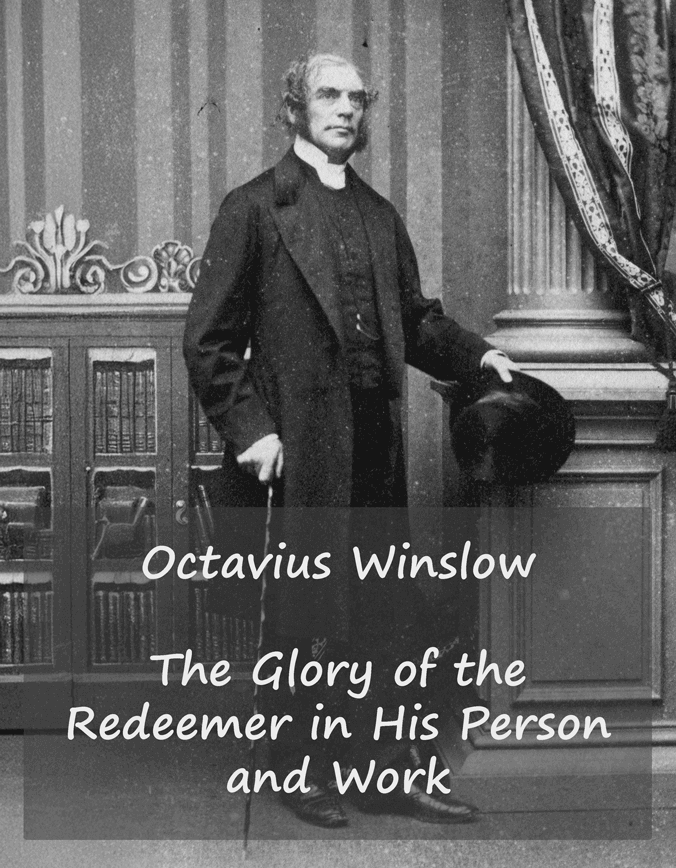
Latest Completed Audiobook: Octavius Winslow’s “The Glory of the Redeemer in His Person and Work”

2 Corinthians 9:15 – “Thanks be unto God for his unspeakable gift.

Finally (which for me has taken over a year and a half since I started), I finished recording our next audiobook “The Glory of the Redeemer in His Person and Work” from Octavius Winslow.

I hadn’t read it myself up to this point, but I figured I couldn’t go wrong:

  • With a book from Octavius Winslow
  • Where he examines Christ Jesus’s glory in detail

And I wasn’t disappointed! 🙂

This is Reformed Heritage Books’ publication of Mr. Winslow’s work, and from the back, here’s a description:

Octavius Winslow (1808-1878) has long been highly regarded for his warm engagement of biblical truth. In The Glory of the Redeemer, Winslow delivers a devotional Christology that will excite the believer’s soul. He examines the person and work of Christ, tracing Jesus’s glory from the eternal existence of His divine nature, through the Old Testament types and shadows, and through His humiliation and exaltation in the New Testament up to and including His second coming. Read Winslow’s treatment of our great Redeemer and see how good theology naturally leads to hearty doxology!

Some time ago, I started reading Puritan and other similar writings in order to bring them to the audio medium for those who prefer to listen to things rather than read them, so that those people might still have available to them these means of grace from God’s servants of the past they might not use if only print was available.

All of the writings are on our audiobooks page, and it is just our prayer that God would bless someone with them.

May the glory of our blessed Redeemer ever grow in our hearts and minds in this life, and may we grow in adoration of Him now, and one day in His presence forever!

— David

David’s Digest: A Closer Look at Jesus’ Response to the Devil’s Temptations

I believe it was the last time I read through these that I wondered if I could see any common thread amongst each of Jesus’ responses.

Here is Matthew’s account, with the responses highlighted:

Matthew 4:1-11:

1 Then was Jesus led up of the Spirit into the wilderness to be tempted of the devil.

2 And when he had fasted forty days and forty nights, he was afterward an hungred.

3 And when the tempter came to him, he said, If thou be the Son of God, command that these stones be made bread.

4 But he answered and said, It is written, Man shall not live by bread alone, but by every word that proceedeth out of the mouth of God.

5 Then the devil taketh him up into the holy city, and setteth him on a pinnacle of the temple,

6 And saith unto him, If thou be the Son of God, cast thyself down: for it is written, He shall give his angels charge concerning thee: and in their hands they shall bear thee up, lest at any time thou dash thy foot against a stone.

7 Jesus said unto him, It is written again, Thou shalt not tempt the Lord thy God.

8 Again, the devil taketh him up into an exceeding high mountain, and sheweth him all the kingdoms of the world, and the glory of them;

9 And saith unto him, All these things will I give thee, if thou wilt fall down and worship me.

10 Then saith Jesus unto him, Get thee hence, Satan: for it is written, Thou shalt worship the Lord thy God, and him only shalt thou serve.

11 Then the devil leaveth him, and, behold, angels came and ministered unto him.

So, here they are again:

  • It is written, Man shall not live by bread alone, but by every word that proceedeth out of the mouth of God.
  • It is written again, Thou shalt not tempt the Lord thy God.
  • Get thee hence, Satan: for it is written, Thou shalt worship the Lord thy God, and him only shalt thou serve.

I had already learned in the past that Jesus used scripture to reply, and you can see that with each having “It is written” in it.

But was there anything else?

In looking at the 2nd and 3rd ones, they have a similar “Thou shalt”, one being positive and the other negative (ie. “Thou shalt not”). Well, that was interesting, and seemed pretty clear and direct responses.

But, Jesus’ response about hunger and stones and bread was confusing to me. It didn’t seem to join with the other replies, and I wondered why He didn’t use a “Thou shalt” there. And was this just some answer that spiritual things are more important than physical? That’s kind of what that answer seemed to me to be.

And then I wondered, where was the “not bread alone” written that was a reference for Christ? Well, I found it to be in Deuteronomy. Here it is:

Deuteronomy 8:3 – “3 And he humbled thee, and suffered thee to hunger, and fed thee with manna, which thou knewest not, neither did thy fathers know; that he might make thee know that man doth not live by bread only, but by every word that proceedeth out of the mouth of the Lord doth man live.

Hmm…interesting. There it is, but it still didn’t really shed any light.

And that’s when I stepped back and said, let’s see what the context is. Here’s the section:

Deuteronomy 8:1-6:

1 All the commandments which I command thee this day shall ye observe to do, that ye may live, and multiply, and go in and possess the land which the Lord sware unto your fathers.

2 And thou shalt remember all the way which the Lord thy God led thee these forty years in the wilderness, to humble thee, and to prove thee, to know what was in thine heart, whether thou wouldest keep his commandments, or no.

3 And he humbled thee, and suffered thee to hunger, and fed thee with manna, which thou knewest not, neither did thy fathers know; that he might make thee know that man doth not live by bread only, but by every word that proceedeth out of the mouth of the Lord doth man live.

4 Thy raiment waxed not old upon thee, neither did thy foot swell, these forty years.

5 Thou shalt also consider in thine heart, that, as a man chasteneth his son, so the Lord thy God chasteneth thee.

6 Therefore thou shalt keep the commandments of the Lord thy God, to walk in his ways, and to fear him.

And there it was! The context was keeping God’s commandments!

Here’s a paraphrase recap:

  • Do all the commandments I give you.
  • Remember how I tried you in the wilderness to see if you would keep My commandments.
  • How that testing was hunger, but I provided manna to eat so you’d know what comes out of My mouth is what man lives by.
  • I took care of you and chastened you.
  • So given all of that, keep My commandments, walk in My ways, and fear Me.

It seemed apparent to me then that “every word that proceedeth out of the mouth of the Lord” from verse 3 were His commandments.

And now, it all tied back together to Christ’s responses to the devil:

  • Man lives by keeping God’s commandments
  • Keep the commandment of not tempting God
  • Keep the commandment of worshiping only Him

But in application to ourselves, I believe the inference from this is what our response to Satan’s temptations should be,

No, God says this. I’m going to obey God.

And after all, what really are the devil’s temptations but temptation to sin? And what is sin but not keeping God’s commandments? (1 John 3:4)

But then, we need to know what God’s commandments are and how He would have us live and obey Him, and the only source of that is His word, the Bible. So, we need to be diligent then in our studies of it.

May God give us this desire to be obedient to Him over all temptations to sin — our own carnal man’s, the devil’s, and those from the world. May the Lord grant us an understanding of His commandments and then the graces to indeed be obedient. And may He grant we do so wholeheartedly from our hearts out of love for Him!

John 14:15 – “If ye love me, keep my commandments.

John 14:21 – “He that hath my commandments, and keepeth them, he it is that loveth me: and he that loveth me shall be loved of my Father, and I will love him, and will manifest myself to him.

1 John 2:3-5 – “3 And hereby we do know that we know him, if we keep his commandments. 4 He that saith, I know him, and keepeth not his commandments, is a liar, and the truth is not in him. 5 But whoso keepeth his word, in him verily is the love of God perfected: hereby know we that we are in him.

1 John 5:2-3 – “ By this we know that we love the children of God, when we love God, and keep his commandments. 3 For this is the love of God, that we keep his commandments: and his commandments are not grievous.

— David

David’s Digest: A Brief Look at Fasting for Spiritual Purposes

Fasting is in the Bible, and God’s people would sometimes fast for spiritual purposes. Here are just a few instances:

Psalm 35:13 – “But as for me, when they were sick, my clothing was sackcloth: I humbled my soul with fasting; and my prayer returned into mine own bosom.

Daniel 9:3 – “And I set my face unto the Lord God, to seek by prayer and supplications, with fasting, and sackcloth, and ashes:

Acts 14:23 – “And when they had ordained them elders in every church, and had prayed with fasting, they commended them to the Lord, on whom they believed.”

Esther 4:1-3:

1 When Mordecai perceived all that was done, Mordecai rent his clothes, and put on sackcloth with ashes, and went out into the midst of the city, and cried with a loud and a bitter cry;

2 And came even before the king’s gate: for none might enter into the king’s gate clothed with sackcloth.

3 And in every province, whithersoever the king’s commandment and his decree came, there was great mourning among the Jews, and fasting, and weeping, and wailing; and many lay in sackcloth and ashes.

Esther 4:15-16:

15 Then Esther bade them return Mordecai this answer,

16 Go, gather together all the Jews that are present in Shushan, and fast ye for me, and neither eat nor drink three days, night or day: I also and my maidens will fast likewise; and so will I go in unto the king, which is not according to the law: and if I perish, I perish.

Even the heathen somehow knew about fasting:

Jonah 3:4-5, 10:

4 And Jonah began to enter into the city a day’s journey, and he cried, and said, Yet forty days, and Nineveh shall be overthrown.

5 So the people of Nineveh believed God, and proclaimed a fast, and put on sackcloth, from the greatest of them even to the least of them.

10 And God saw their works, that they turned from their evil way; and God repented of the evil, that he had said that he would do unto them; and he did it not.

It’s all over in the Bible actually.

In the following, Christ discusses it. I believe I always thought they were changing their face because of the hunger pangs, or at least the appearance of hunger pangs. I think it makes some sense, hunger a pretext for a “sad countenance”:

Matthew 6:16-18:

16 Moreover when ye fast, be not, as the hypocrites, of a sad countenance: for they disfigure their faces, that they may appear unto men to fast. Verily I say unto you, They have their reward.

17 But thou, when thou fastest, anoint thine head, and wash thy face;

18 That thou appear not unto men to fast, but unto thy Father which is in secret: and thy Father, which seeth in secret, shall reward thee openly.

And then it’s mentioned here regarding the demon coming out. I believe I never really understood this, which aligned with my not understanding fasting mentioned in Christ’s admonition above:

Mark 9:28-29:

28 And when he was come into the house, his disciples asked him privately, Why could not we cast him out?

29 And he said unto them, This kind can come forth by nothing, but by prayer and fasting.

So, my struggle has always been, “How does me not eating have anything to do with the fervency of an issue, such as prayer. Can I not pray earnestly and still eat something during the day? How does that prove earnestness or otherwise with God?”

Well, one time recently while reading through the New Testament, I can across this:

Matthew 9:14-15:

14 Then came to him the disciples of John, saying, Why do we and the Pharisees fast oft, but thy disciples fast not?

15 And Jesus said unto them, Can the children of the bridechamber mourn, as long as the bridegroom is with them? but the days will come, when the bridegroom shall be taken from them, and then shall they fast.

And there it was! Jesus actually describes generally what fasting is (paraphrased here):

The question to Jesus: “Why don’t your disciples fast?”

Jesus’ answer: “Why would they mourn with me still here? When I am gone, then they’ll fast.”

I believe Jesus then is indicating that fasting then, generally, is a time of mourning.

Then, the Ninevites actions makes sense. So do the Esther instances (the first one even mentioned mourning with fasting). The distraught faces of the Pharisees during fasting makes better sense.

Now, do we need to fast?

(The following argument I learned from one or more sermons I had heard.)

Note here about praying:

Matthew 6:5-8:

5 And when thou prayest, thou shalt not be as the hypocrites are: for they love to pray standing in the synagogues and in the corners of the streets, that they may be seen of men. Verily I say unto you, They have their reward.

6 But thou, when thou prayest, enter into thy closet, and when thou hast shut thy door, pray to thy Father which is in secret; and thy Father which seeth in secret shall reward thee openly.

7 But when ye pray, use not vain repetitions, as the heathen do: for they think that they shall be heard for their much speaking.

8 Be not ye therefore like unto them: for your Father knoweth what things ye have need of, before ye ask him.

Jesus said “when you pray.” There’s an implicit statement in there that there’s no question prayer will be done by His people. I think most Christians would agree that Christians should pray.

Well, going back to verse 16 of Matthew 6 again, Jesus says “when you fast.” I believe we can draw the same inference from that — that there is an expectation by God that Christians should fast.

But, isn’t God all knowing? Why pray? Going back to Matthew 6, verse 7-8 now:

7 But when ye pray, use not vain repetitions, as the heathen do: for they think that they shall be heard for their much speaking.

8 Be not ye therefore like unto them: for your Father knoweth what things ye have need of, before ye ask him.

God knows what you need, yes, but there it is again, the implication that you still will pray.

Further, God says in Ezekiel 36:37:

Thus saith the Lord God; I will yet for this be enquired of by the house of Israel, to do it for them; I will increase them with men like a flock.

He knows all things, and yet He will be enquired of.

So, why pray? God requires it, implies that it should happen, and I believe has prescribed it as a means by which He often accomplishes His will.

Here, God tells Elijah what He’s going to do:

1 Kings 18:1 – “And it came to pass after many days, that the word of the Lord came to Elijah in the third year, saying, Go, shew thyself unto Ahab; and I will send rain upon the earth.

But then:

1 Kings 18:42-45:

42 So Ahab went up to eat and to drink. And Elijah went up to the top of Carmel; and he cast himself down upon the earth, and put his face between his knees,

43 And said to his servant, Go up now, look toward the sea. And he went up, and looked, and said, There is nothing. And he said, Go again seven times.

44 And it came to pass at the seventh time, that he said, Behold, there ariseth a little cloud out of the sea, like a man’s hand. And he said, Go up, say unto Ahab, Prepare thy chariot, and get thee down that the rain stop thee not.

45 And it came to pass in the mean while, that the heaven was black with clouds and wind, and there was a great rain. And Ahab rode, and went to Jezreel.

James 5:17-18:

17 Elias was a man subject to like passions as we are, and he prayed earnestly that it might not rain: and it rained not on the earth by the space of three years and six months.

18 And he prayed again, and the heaven gave rain, and the earth brought forth her fruit.

So, Elijah still prayed, even though God had already planned to bring about the rains. I believe this shows Elijah’s prayers were means for the manifestation of God’s will.

And I believe then, this follows through for fasting — it’s a means God has set up for the accomplishment of His will at times.

Back above in Mark, the demon would only come out with prayer and fasting? Why? It appears those two things were the required means for its accomplishment.

Did not God in His sovereign omniscience know in the end He was not going to destroy the Ninevites? But what was the means they went through for that? Prayer and fasting.

And so, to conclude, I believe fasting is:

  • A time of mourning
  • A required duty of Christians, at the right times, maybe especially when there’s a burden on the heart, for someone, for some situation, etc.
  • Often tied to prayer
  • A means whereby at times God manifests His will

Thank the Lord for the unspeakable gift of His blessed Son, the Lord Jesus, by Whom we have access to the Father, to even be able to pray and fast, and that He hears our prayers because of the Christ Jesus!

— David

David’s Digest: Hearts to Give Ourselves in All to Our Beloved

Song of Solomon 6:3 – “I am my beloved’s, and my beloved is mine: he feedeth among the lilies.

In Song of Solomon, the Bride, or Church of the Lord Jesus Christ, declares that she is her Beloved’s and that He is hers.

In his excellent treatise on Song of Solomon 4:16-6:3 called “Bowels Opened” (bowels being inner-most self, often referencing deep compassions for others), Puritan Richard Sibbes notes how we are Christ’s beloved.

He says:

  • By His Father’s gift
  • By redemption
  • By marriage
  • And by our consent

He then notes some uses of understanding these things:

  • Use 1: It brings comfort to us, in that God will not allow his own to lack anything needful
  • Use 2: It fences us from Satan’s accusations, that he can go to our Beloved with any of them
  • Use 3: We can go to Christ in times of difficulty. And that the difficulties are used to:
    • Conform the spouse to the husband in sufferings
    • To bring Christ and spouse nearer together in her seeking Him and Him indeed being there
    • And to know this time on earth of sufferings will end not long from now

And then Mr. Sibbes continues with Use 4 — to try us if we are Christ’s.

But how?

Below we pick up with answer to that. You can read this section of the treatise here, or listen to the sermon with this part in it here (it’s near the end), or listen to the entire treatise on our audio book page.

From Richard Sibbes:

4. Hence we have also an use of trial. Whosoever are Christ’s, they have hearts to give themselves to him.

As he gives himself, not his goods or his honours, but himself for his church, so the church gives herself to Christ. My delight is in him; he has myself, my heart, my love and affection, my joy and delight, and all with myself.

If I have any honour, he shall have it. I will use it for his glory. My riches I will give them to him and his church and ministry and children, as occasion shall serve. I am his, therefore all that I have is his, if he ask it at my hands.

It is said of the Macedonians, they gave themselves to Christ, and then their riches and goods, 2 Cor. 8:5. It is an easy matter to give our riches to Christ when we have given ourselves first.

A Christian, as soon as ever he becomes a Christian, and ever after, to death, and in death too, he gives up himself to Christ. They that stand with Christ, and will give this or that particular, will part only with idle things that they may spare, are they Christ’s? No. A Christian gives himself and all his to Christ.

So we see here what we should do if Christ be ours. Let us give up ourselves to him, as it is in Rom. 12:1. The issue of all that learned profound discourse in the former part of the epistle, that Christ justifies us by his righteousness and merit, and sanctifies us by his Spirit, and has predestinated and elected us, and refused others, is this, ‘I beseech you, give up your bodies and souls, and all as a living sacrifice, holy and acceptable unto God.’

In brief, these words imply renunciation and resignation. ‘I am his,’ that is, I have given up myself to him, therefore I renounce all others that stand not with his love and liking. I am not only his by way of service, which I owe him above all that call for it, but I am his by way of resignation. If he will have me die, I will die. If he will have me live here, I will. I have not myself to dispose of any longer. I have altogether alienated myself from myself. I am his to serve him, his to be disposed of by him. I have renounced all other.

Therefore here we have another answer to Satan, if he come to us and solicit us to sin. Let the Christian’s heart make this answer, I am not mine own.

What has Satan and his instruments to do with me? Is my body his to defile? Is my tongue his to swear at his pleasure? Shall I make the temple of God the member of an harlot? As the apostle reasons, ‘Shall I defile my vessel with sin?’ 1 Cor. 6:15. What says converted Ephraim? ‘What have I any more to do with idols? for I have seen and observed him?’ Hos. 14:8.

We ought to have such resolutions ready in our hearts. Indeed, when a Christian is resolute, the world counts such to be lost. He is gone. We have lost him, say your dissolute, profane persons. It is true they have lost him indeed, for he is not his own, much less theirs, any longer. But he is found to God and himself and the church.

Thus we see what springs from this, that Christ is ours, and that we are Christ’s back again. Let us carry this with us even to death; and if times should come that God should honour us by serving himself of us in our lives, if Christ will have us spend our blood, consider this, I am not mine own in life nor death, and it is my happiness that I am not my own.

For if I were mine own, what should I do with myself? I should lose myself, as Adam did. It is therefore my happiness that I am not mine own, that I am not the world’s, that I am not the devil’s, that none else hath to do with me, to claim any interest in me, but I am Christ’s.

If I do anything for others, it is for Christ’s sake. Remember this for the time to come. If there be anything that we will not part with for Christ’s sake, it will be our bane [deadly poison, destruction]. We shall lose Christ and it too. If we will not say with a perfect spirit, I am his, my life, my credit, my person is his, anything his; look what we will not give for him, at length we shall lose and part with it and him too.

May God grant us this desire for Christ above all, to have Him, to love and serve Him above all, and the desire and help to give ourselves in total to Him, for the glory of His name!

— David

David’s Digest: Is Christ Altogether Lovely? – Part 3

Song of Solomon 5:16 – “His mouth is most sweet: yea, he is altogether lovely. This is my beloved, and this is my friend, O daughters of Jerusalem.

In Song of Solomon, the Bride, or Church of the Lord Jesus Christ, declares that He is “altogether lovely” to her.

But what does that look like?

In his excellent treatise on Song of Solomon 4:16-6:3 called “Bowels Opened” (bowels being inner-most self, often referencing deep compassions for others), Puritan Richard Sibbes gives his view on what it means for Jesus to be altogether lovely to a Christian.

You can read this section of the treatise here, or listen to the sermon with this part in it here, or listen to the entire treatise on our audio book page.

Continuing from Part 2, here is the final part from Richard Sibbes, Part 3:

‘He is altogether lovely.’

To conclude this point, let us try our affections by the church’s affections in this place, whether Christ be so lovely to us or not. It is said, ‘There is no beauty in him when we shall see him, and he was despised of men,’ Isa. 53:2.

He was so, in regard of his cross and sufferings, to the eye of the world and of carnal men. Herod scorned him; when Pilate sent him to him, made nobody of him, as the word in the original is. They looked upon the outside of Christ in the flesh when he was abased. ‘There was no form nor beauty in him,’ saith the Holy Ghost, that is, to the sight of carnal men; but those that had the sight of their sins with spiritual eyes, they could otherwise judge of Christ. The poor centurion saw an excellency in him when he said, ‘He was not worthy that he should come under his roof,’ Mat. 8:8. The poor thief saw the excellency of Christ upon the cross in those torments. ‘Lord, remember me when thou comest into thy kingdom,’ Luke 23:42.

So those souls that were enlightened, that had the sight of their misery and the sight of God’s love in Christ, had a high esteem of Christ in his greatest abasement. Therefore, if we have a mean [low] esteem of the children of God as contemptible persons, and of the ordinances of God as mean [low] things, and of the government of Christ (such as he hath left in his word) as base, it is an argument of a sinful, unworthy disposition. In such a soul Christ hath never been effectually by his Spirit; for everything in him is lovely, even the bitterest thing of all. There is a majesty and excellency in all things of Christ. The censures of the church are excellent when they proceed and issue forth with judgment, as they should do, ‘to deliver such a man over to Satan, that he may be saved in the day of the Lord,’ 1 Cor. 5:5.

Now, if the ordinances of Christ, the word and sacraments, and the shutting sinners [the notorious ones, as noted in the last paragraph] out of the church, if these things be vilified as powerless things, it shews a degenerate, wicked heart, not acquainted with the ways of God.

If we have a mean [low] esteem of men that suffer for Christ and stand out for him, if we account them so and so, shall we think ourselves Christians in the mean time? When Christ is altogether lovely, shall they be unlovely that carry the image of Christ? Can we love him that begets, and hate them that are begotten of him? Can we love Christ, and hate Christians? It cannot be.

Now, that we may get this affection and esteem of Christ that is so lovely,

Let us labour to make our sins bitter and loathsome, that Christ may be sweet.

Quest. What is the reason we set no higher a price of Christ?

  1. Ans. Because we judge not of ourselves as we are indeed, and want [lack] spiritual eye-salve to see into ourselves rightly.

  2. And let us attend upon the means of salvation, to hear the unsearchable riches of Christ. What makes any man lovely to us, but when we hear of their riches, beauty, and good intent to us? In the word we are made acquainted with the good intent of Christ towards us, the riches of mercy in forgiving our sins, and riches of glory prepared for us. The more we hear of him, of his riches and love to us, the more it will inflame our love to Christ.

    Those that live where the ordinances of Christ are held forth with life and power, they have more heavenly and enlarged affections than others have, as the experience of Christians will testify.

  3. Again, if we would esteem highly of Christ that he may be lovely to us, let us join with company that highly esteem of Christ, and such as are better than ourselves. What deads [deadens] the affections so much as carnal, worldly company, who have nothing in them but civility?

    By converse with them who have discourse of nothing but the world, if a man have heavenly affections, he shall quickly dull them, and be in danger to lose them. They may be conversed with in civil things, but when we would set to be heavenly and holy minded, let us converse with those that are of an heavenly bent.

    As we see here, ‘the daughters of Jerusalem’ are won to love Christ. By what? By conversing with the church. Upon the discourse that the church makes of his excellencies, in particular, they begin to ask, Where is Christ, as in the next chapter [of Song of Solomon]; and so are all brought to the love of Christ.

May the Lord grant us an ever increasing view of the altogether loveliness of Himself!

— David

David’s Digest: Is Christ Altogether Lovely? – Part 2

Song of Solomon 5:16 – “His mouth is most sweet: yea, he is altogether lovely. This is my beloved, and this is my friend, O daughters of Jerusalem.

In Song of Solomon, the Bride, or Church of the Lord Jesus Christ, declares that He is “altogether lovely” to her.

But what does that look like?

In his excellent treatise on Song of Solomon 4:16-6:3 called “Bowels Opened” (bowels being inner-most self, often referencing deep compassions for others), Puritan Richard Sibbes gives his view on what it means for Jesus to be altogether lovely to a Christian.

You can read this section of the treatise here, or listen to the sermon with this part in it here, or listen to the entire treatise on our audio book page.

Continuing from Part 1, here is from Richard Sibbes, Part 2:

‘He is altogether lovely.’

Use 4. And let us make an use of trial, whether he be thus lovely to us, or no. We may see hence whether we love Christ or no. We may judge of our love by our esteem.

  1. How do we value Christ? what price doth the church set on him? ‘He is the chief of ten thousand.’ What place, then, should he have in our hearts? If he be the chief of ten thousand, let us rather offend ten thousand than offend him.

    Let us say, with David, ‘Whom have I in heaven but thee?’ etc., Ps. 73:25. And when the soul can say to Christ, or any that is Christ’s (for I speak of him in the latitude of his truths, promises, sacraments, and communion with his children), ‘What have I in heaven but thee?’ etc., then it is in a happy condition.

    If these things have the same place in our esteem, as they have in respect of their own worth, then we may say truly, without hypocrisy, ‘He is altogether lovely to us,’ that we truly love him.

  2. In the next place, are we ready to suffer for Christ? We see the church here endures anything for Christ. She was misused of the watchmen. They scorned her, and her ‘veil is taken away,’ yet notwithstanding, she loves Christ still. Do we stand ready disposed to suffer for Christ? of the world to be disgraced and censured? and yet are we resolved not to give over? Nay, do we love Christ the more, and stick to his truth the faster? Certainly where the love of Christ is, there is a spirit of fortitude, as we may see in the church here, who is not discouraged from Christ by any means. He is still the chief of ten thousand.

    When she was wronged for seeking after him, yet he was altogether lovely. Whereas, on the other hand, you have some that, for frowns of greatness, fear of loss, or for hope of rising, will warp their conscience, and do anything. Where now is love to Christ and to religion? He that loves Christ, loves him the more for his cross, as the Holy Ghost hath recorded of some, that they ‘rejoiced that they were thought worthy to suffer for Christ,’ Acts 5:41.

    So the more we suffer for him, the more dear he will be to us. For indeed he does present himself in love and comfort most, to those that suffer for his sake; therefore their love is increased.

  3. Again, where love is, there it enlarges the heart, which being enlarged, enlarges the tongue also. The church hath never enough of commending Christ, and of setting out his praise. The tongue is loosed, because the heart is loosed. Love will alter a man’s disposition.

    As we see in experience, a man base of nature, love will make him liberal; he that is tongue-tied, it will make him eloquent. Let a man love Christ, and though before he could not speak a word in the commendation of Christ, and for a good cause, yet, I say, if the love of Christ be in him, you shall have him speak and labour earnestly in the praises of God. This hot affection, this heavenly fire, will so mould and alter him, that he shall be clean another man.

    As we see in the church here, after that there was kindled a spirit of love in her, she cannot have done with Christ. When she had spoke what she could, she adds, ‘He is altogether lovely.’ Those that cannot speak of Christ, or for Christ, with large hearts in defence of good causes, but are tongue-tied and cold in their affections, where is their love?

    Put any worldly man to a worldly theme that he is exercised in, and speaks of daily, he has wit and words at will; but put him to a theme of piety, you lose him: he is out of his theme, and out of his element. But ’tis not so with those that have ever felt the love of God in Christ. They have large affections. How full is Saint Paul! He cannot speak of Christ, but he is in the height, breadth, length, and depth of the love of God in Christ, and the knowledge of God above all knowledge. Thus we may discern the truth of our love by the expressions of it here as in the church.

  4. Again, the church here is never content till she find Christ; whatsoever she had, nothing contents her. She wanted [lacked] her beloved. As we see here, she goes up and down inquisitive after him till she find him.

    So it is with a Christian. If he have lost, by his own fault, his former communion with Christ, he will not rest nor be satisfied; but searches here and there in the use of this and that means. He runs through all God’s ordinances and means till he find Christ. Nothing in the world will content him, neither honour, riches, place, or friends, till he find that which he once enjoyed, but hath now for a season lost, the comfort and assurance of God’s love in Christ.

Now, if we can sit down with other things, and can want [lack] Christ and the assurance of salvation, that sweet report of the Spirit that we are his, and yet be contented well enough, here is an ill sign that a man is in an ill condition. The church was not so disposed here. She was never quiet, nor gives over her inquisition and speaking of Christ (that by speaking of the object she might warm her affections), until at the last she meets with Christ. These and the like signs there are of the truth of the love of Christ.

But where there is a flaming love of Christ there is this degree further, a desire of the appearance of Christ, a desire of his presence. For if Christ be so lovely in his ordinances, if we find such sweetness in the word and sacraments, in the communion of saints, in the motions of the Spirit, what is the sweetness, think you, which the souls in heaven enjoy, where they see Christ face to face, see him as he is? Hereupon the spouse saith, ‘Let him kiss me with the kisses of his mouth.’ Oh, that I might live in his presence. This is the desire of a Christian soul when the flame of love is kindled in any strength, ‘Oh, that I might see him.’

And therefore it longs even for death; for as far as a man is spiritual, he desires to be dissolved and to be with Christ; as Simeon, when he saw him, though in his abasement, ‘Now I have enough; let thy servant depart in peace, for mine eyes have seen thy salvation,’ Luke 2:30.

The presence of Christ, though it were but in the womb, when Mary, the mother of Christ, came to Elizabeth, it caused the babe that was in her womb to spring. Such comfort there is in the presence of Christ, though he be but in the womb, as it made John to spring.

What, then, shall be his presence in heaven? How would it make the heart spring there, think you? For that which is most lovely in Christ is to come. Therefore the saints that have any degree of grace in the New Testament, they are set out by this description. They were such as loved the appearing of our Lord Jesus Christ. How can it be otherwise? If they love Christ, they love the appearing of Christ, wherein we shall be made lovely, as he is lovely.

Here we are not ‘altogether lovely;’ for we have many dregs of sin, many infirmities and stains. Shall we not, then, desire that time wherein, as he is ‘altogether lovely,’ so shall we be made a fit spouse for so glorious a husband?

Continue on to Part 3!

— David

« Older posts