The Sifford Sojournal

Our journal of what we pray is our sojourn of life along the narrow way, even the old paths, submitting to the Bible as a light unto both.

Page 58 of 94

David’s Digest: Entitlement

A few years ago, our teacher had mentioned something about being careful about not having a sense of entitlement. I hadn’t really ever considered that, and started to really ponder how I might be having a sense of entitlement.

What am I entitled to in this life?

As a sinner, I’m entitled to the wages of my sin: death (Rom 6:23) — physical, spiritual and eternal.

One of the first things I remember where I really saw it in myself was during the drought summer. It was day after day of relentless 100+ degree F heat. It was difficult, and I found myself murmuring about it.

I’ve always struggled when any of the animals we have die, as I talked about several years ago in this blog post, although it seems the Lord has granted some graces since then in this area.

Last year, when some things were being taken that I felt shouldn’t, I reacted extremely carnally toward the people, confronting them angrily, yelling at them. I felt badly about it that night and asked God to forgive me for that, and for besmirching His name and the group, and the next day I apologized to those involved, and my reaction was disgusting to me.

But my reaction really got me examining myself. Am I entitled to any temporal thing, as if God owes me something? Comfort, a place to live, the animals, shelter, money, a family, successful gardens or crops (even if I do all of the right things with them), good health, nourishment from our daily bread (which is one reason we say meal blessings, and as a type of asking for nourishment from spiritual food)…….my next heartbeat…….anything?

And then something clicked. I have been seeing things from my carnal, in-the-moment vantage point, and not seeing them as God sees them. I have been holding on to things temporal, when in reality everything is His to do with as He pleases, in any way He wants; every temporal thing around me is really just a fleeting vapor in time; whatever He is doing — in the temporal or spiritual realms — is for His glory and the benefit of His Church. And I saw my sense of entitlement.

And a sense of entitlement inevitably leads to ungratefulness.

In the end, am I really entitled to anything temporal? Life, liberty and the pursuit of happiness? How would that be answered in light of the Christian martyrs? Or with regards to those who have spent year after year after year in prison for Christ’s sake? How about all the times He allowed His people to come under bondage? If temporal freedom is an entitlement to man from God, and since God is all-powerful and sovereign over all, then it would seem to me that it follows that God would have failed in supplying man’s just due, thus making Him unjust, which obviously cannot be.

Am I my own? As Jonathan Edwards mentioned in “Charity and Its Fruits,” I am not my own — God owns me, and in each situation, I am due worse because of sin, and anything better than that is a grace and mercy from our Creator.

Am I entitled to things going “my way”? ANY thing to go “my way”? To go according to my expectations? I believe God is the only One entitled to such, and it also seems to me any sense of expecting things to go how I want them (ie. entitlement) is putting myself as god. Plus, even my best thoughts on how things should go are going to be tainted with sin, so why should I put any trust in them? Why shouldn’t I put my trust in Him who is all knowing, all wise, all good, all righteous, and all holy?

Is anything actually “mine”? Everything is God’s; and so, if anything is “taken from me,” even unjustly, it is by God’s sovereign will they were, for His glory. And so, there is nothing supporting any sense of entitlement to anything that I might think is mine, which is really only God putting it under my care for whatever time-span He deems right.

How about Job? First, by God’s decree, “his” things were taken from him, one might say “unjustly” (ie. not for anything specific he did). But second, Elihu upbraided him for justifying himself more than justifying God and His providence — see Puritan commentator John Gill’s commentary on Job 32:2, and then read the entire exchange between God and Job, and Job’s eventual responses (including his first response, which wasn’t good enough for God), in Job 32-42. The irony is that denying God’s justice in anything, even perceived injustices, is charging God with injustice.

Further, while I should observe Luke 6:31, “And as ye would that men should do to you, do ye also to them likewise”, am I entitled to receive the same from others? What did the Lord Jesus, who actually *was* entitled to all glory, honor and respect, face here on earth?

Matt 22:15 – “Then went the Pharisees, and took counsel how they might entangle him in his talk.

Ps 56:5-6 – “5 Every day they wrest my words: all their thoughts are against me for evil. 6 They gather themselves together, they hide themselves, they mark my steps, when they wait for my soul.

Matt 26:14,16 – “14 Then one of the twelve, called Judas Iscariot, went unto the chief priests,…16 And from that time he sought opportunity to betray him.

Luke 19:47 – “And he taught daily in the temple. But the chief priests and the scribes and the chief of the people sought to destroy him,

Matt 27:20 – “But the chief priests and elders persuaded the multitude that they should ask Barabbas, and destroy Jesus.

And then they murdered Him (Acts 2:22-24).

If I want to follow Christ, here’s what I can expect, and what’s expected of me, since the servant is not above his master (Matt 10:24; Gill on Matt 10:24):

Luke 9:23 – “And he said to them all, If any man will come after me, let him deny himself, and take up his cross daily, and follow me.

John Gill says “that afflictions, trials, and persecutions of one sort or another, are to be expected every day by the people of God, and to be continually submitted to, and borne with cheerfulness.” (emphasis added); and we learn that Christ even grew in the exercise of graces through His sufferings (Heb 5:8).

And then I ask for Jehovah God to help me wait on Him, in His perfect will, with strength of heart and courage (Ps 27:11-14), and be still and know that He is God (Ps 46).

Finally and briefly, am I entitled to salvation or God’s graces just because I say a prayer? To enlightenment from His word just because I read it? To the means of grace (the Bible, in my own language; teachings; etc.) themselves? These are all of grace, although I can and should indeed ask for them (for example, asking God for spiritual nourishment from our daily spiritual bread).

Anything I have has been sovereignly given to me out of pure grace and mercy from the Lord of all creation, all for His glory and in some way for the good of His Church (Rom 8:28; see Gill on this verse too), and I believe myself individually to be generally inconsequential in the matter.

I pray the Lord have mercy on me a sinner (Luke 18:13). I pray for forgiveness for my sense of entitlement and unthankfulness, and pray God grants me repentance from those, and help against them. May we see things as God sees them, and not hold on to anything in the temporal; may we pick up our cross daily, cheerfully, deny ourselves, and follow the Lord Christ; may He grant help in the cross-bearing; may we be thankful for His help and any graces He mercifully grants; and may He grant that His grace be sufficient for us:

2 Cor 12: 9 – “And he said unto me, My grace is sufficient for thee: for my strength is made perfect in weakness. Most gladly therefore will I rather glory in my infirmities, that the power of Christ may rest upon me.

Gill:

And he said unto me
Either by what the Jews call (lwq) (tb) , “Bath Kol”, a voice from heaven, an articulate audible one; or by some extraordinary revelation of the Spirit of God; or by a divine impression upon his mind; whereby he was assured of what follows,

my grace is sufficient for thee;
the Lord always hears and answers his people sooner or later, in one form or another, though not always in the way and manner they desire; but yet in such a way as is most for his glory and their good: the apostle had not his request granted, that Satan might immediately depart from him, only he is assured of a sufficiency of grace to support him under the exercise, so long as it should last. There seems to be an allusion to the word (ydv) , “Shaddai”, an appellation of God, ( Genesis 17:1 ) , and signifies, “which is sufficient”: for God is all sufficient, and is a name that belongs to the Messiah. The angel whom God promised to the Israelites, to go before them in the wilderness, ( Exodus 23:23 ) , the Jews say is “Metatron” (which is a corruption of the word “mediator”), whose name is as the name of his master. “Metatron” by gematry is “Shaddai, one that is sufficient”: however, certain it is, that the grace of Christ is alone sufficient for all his people, to all saving purposes, in all their times of need. It is alone sufficient, not to the exclusion of the grace of the Father or the Spirit; but in opposition and distinction to anything else, that may be rightly or wrongly called grace; what men generally call common or sufficient grace, which, they say, is given to all men, is a mere chimera; no grace is sufficient but what is effectual, and that is only the grace of Christ: the light of nature is insufficient to any saving purpose; the Gospel, which is called grace, and is the means of grace, is insufficient of itself to salvation, without the powerful and efficacious grace of Christ going along with it; and so are gifts, whether ordinary or extraordinary: nothing short of the grace of Christ is sufficient grace; and this is sufficient for all the elect of God, Jews and Gentiles, Old and New Testament saints, the family in heaven and in earth, the people of God that are already called, and are to be called, and for the worst and vilest of sinners; and it is sufficient to all saving purposes, to the acceptance of their persons before God, to their justification in his sight, to their pardon and cleansing, to their regeneration and sanctification, to the supply of all their wants, and to their perseverance in grace unto glory; and it is sufficient in all their times of need, in times of bodily affliction, of violent persecution, soul desertion, Satan’s temptations, and at the hour of death, and in the day of judgment. The reason given to support this answer, and to strengthen the apostle’s faith in it, is,

for my strength is made perfect in weakness;
by the “strength” of Christ is meant, not his strength as the mighty God, but that communicative strength which he has, and is in him as Mediator, and which saints look to him for, and receive from him; this is “made perfect in” their “weakness”; not that their weakness can add perfection to his strength, for his strength is perfect in itself, not to say anything of the contradiction such a sense carries in it; but the meaning is, that the strength of Christ is made to appear, is illustrated and shines forth in its perfection and glory, in supplying, supporting, and strengthening his people under all their weakness; and if they were not left to some weaknesses in themselves, his strength would not be so manifest; see ( James 2:22 ) . The answer to the apostle’s request, supported with this reason, was wonderfully satisfactory to him; wherefore he concludes,

most gladly therefore will I rather glory in my infirmities;
in the weaknesses which attended either his body or soul, through the buffetings of the angel Satan, rather than in his visions and revelations; or rather than insist upon his departure from him, he is content things should be as they were, since he had such a promise of a sufficiency of grace to bear him up, under and through whatever was the pleasure of God concerning him; and since the strength of Christ was made illustrious through his weakness, so that Satan was not able to make any advantage over him, he is willing to remain in the same posture and condition:

that the power of Christ,
says he,

may rest upon me,
or “tabernacle over me”; he considered himself as a poor weak feeble creature, and the power of Christ as a tabernacle over him, as the power of God is represented as a garrison about the believer, ( 1 Peter 1:5 ) , sheltering, preserving, and protecting him from the insults of Satan, in every form and shape; see ( Isaiah 4:6 ) , where Christ is said to be a tabernacle, for a place of refuge, and for a covert.

Amen.

— David

Providence’s Perpetuation Provisions: New Calf “Domingo”

With the new Longhorn calves starting to be born now, the next one I saw was a little brown one walking up with our cow, Holga. After further examination, we discovered he was a bull calf as well; and so, please allow us to introduce you to our next pure Longhorn bull calf, Domingo, which means “belongs to the Lord” in Spanish.

Here he is, with his dam, Holga. You might recognize him from Donato’s video in the last blog post:

New pure Longhorn bull calf Domingo

And here’s his video:


Again, we are very grateful to the Lord for granting the safe delivery for both mama-cow and calf, and us this new little provision!

— David

Providence’s Perpetuation Provisions: New Calf “Donato”

After selling a lot of the herd after the drought in 2011 and because of them eating down the land, we stopped breeding our cattle. But we decided to start breeding them again last year, and apparently it has become that time! The first calf we saw was from our cow Ami maybe 10-11 days ago, a little bull calf; and so, let us introduce to you Donato, which in Spanish means “given by God”!

New Texas Longhorn Bull Calf donato

And here is a video of him:


We’re very grateful to the Lord for granting us the provisions to keep the herd going, including graciously granting some other land close by for us to graze them, and now for this new little extra gift from Providence!

— David
Spay it, Don’t Stray It

Dave and I have learned to look for the spiritual lessons and reminders in just about everything since we moved here. ♫ Big things, ♫ little things, ♫ things that climb ♫ on rocks (ok, enough of the hot dog commercial) but speaking of dogs……er, and cats…..

There has been this little black and white stray cat hanging around the community land for, wow, months now. It has eluded gunshots; it has been chased away by other domestic cats in the community; it has managed to *not* be coyote dinner (and those coyotes can get CLOSE!); it has been through at least two very strong winter cold fronts and seemed to be able to scrounge and hunt and somehow survive. Then one day our neighbor said she believed it was not a feral feline, which come around fairly regularly, but a domestic cat that had been dumped out in the country. Hmmmmm. That put a different light on this cat. It was a true survivor. As they say on Broadway, “Kid, ya got moxie.” So, with Dave’s permission, we started leaving goat milk and food out for it. Slowly, over the course of a few weeks, the cat started coming around during the day when we called it (our other cat, William, was distracted elsewhere) and would come over for food but would not let us pet it. We would leave the food and walk away and it would slowly come up to eat as long as it didn’t feel threatened. By necessity you’d think, it had become extremely skittish and on alert all of the time. Finally, one day I had a breakthrough. Before, I had tried to pet it while it was eating and it would back away every time. (Duh, Sue, how would you like it if someone tried to pet you while you were eating, well, except for Dave 🙂 ) One day I waited quietly until it was finished eating and I just sat there a few feet away. The cat walked about six feet away and started grooming itself, then several minutes later when it was good and ready, it slowly walked back over and cautiously let me pet it. Over the next few days, we continued to earn its trust and the floodgates finally opened. It loved to be petted!

Now that we knew we could capture it, I talked to the lady at the local humane society and she said there was no established method of “adopting” cats in the area and the local pet store had eight that were still waiting to be sold. Dave and I looked online to see if there was a recommended way to try to successfully integrate an existing cat (William) with a new cat. The process, depending on the situation, could take weeks to months. But, since it had become such a good hunter and our options were extremely limited, we thought we’d give it a try.

Well, fast forward a few weeks, we discovered “it” was female, and kept her in our summer kitchen building until we could get her spayed. Dave or I would go in there a few times per day to try to continue the bonding process. After she was spayed, we brought her into the RV with us while she recuperated. Well, she slept and slept and slept and slept and slept and….. I think even aside from the medical procedure, she was now able to really let down in a safe environment and truly rest during her recovery. She had been in ultra survival alert mode for so long, I think she was pretty weary by now. She staked claim at the head of our bed in between our pillows day and night.

Ritzie Laying Against Dave

Now enters William, stage left……. William had also been a stray cat that was very close to getting shot a few years ago but we had taken him in and he has turned out to be a great hunter and valuable member of our homestead. I had seen William get aggressive with this new cat and run her off a couple of times when she was still a stray. So we closed the door to our bedroom when William was inside and kept them totally separated at first. Then we put her in a cage and allowed them to be around each other without contact. Lots of hissing and howling going on at that point. But, slowly, we’ve allowed them supervised contact face to face and they have come to a, kind of, understanding to “purr and let purrr.” They are not friends by any means, and there is still some “tension” but they are able to co-exist pretty well now. We are very thankful for that.

Ummm, William doesn’t seem to be losing much sleep over it:

Our Cat Williams Lounging

I discovered that her markings are labeled “tuxedo” (like Sylvester the cat). Dave thought of the name “Ritzie”, like “puttin’ on the ritz” in a tuxedo. It also sounds like moxie, of which she has lots! So, meet our new rescue cat, Ritzie!

Our New Tuxedo Cat Ritzie

We hope to get her hunting in the barn as soon as she further acclimates herself to all of us and, hopefully, will become another valuable member of this little homestead for however long God allows us to have her.

We don’t know why God has brought her into our lives but we are thankful we could help keep her from a most likely icky fate otherwise, and grant a place where she can be used and valuable. She’s the sweetest little thing, and very affectionate. Oh! And she immediately took to the litter box. Yay!

I have tried to look at the possible spiritual shadow of this situation. Very loosely, I see a shadow of myself, lost in sin and desperately trying to survive in my own strength in a wicked world with spiritual predators all around. Then, as God takes me in and adopts me as His child, He opens my eyes to the “milk” of His word, and over time He teaches me to learn to look to, rest and trust in Him as my Provider, Protector and Refuge. And He transforms my life to be honoring to Him as I perform the good works (Eph. 2:10) I was ordained by Him to do. BUT! If I succumb to spiritual sleep as I feel too comfortable in my new, safe environment, unless I continue to be circumspect and alert for spiritual predators, my spiritual usefulness will be for naught.

Susan

David’s Digest: Charity and Its Fruits, Part 1

The latest sermon series our group has been going through is Jonathan Edwards’ sermon series on “Charity and Its Fruits.” I had originally thought it might be a good series to go through as a group, but as we got into it, to me it is a most critical topic to be covered by anyone who claims to follow Christ.

Initially, we started listening to an audio version of the series I had found online, but sadly the speaker spoke way too fast, and it was very difficult to keep up. And so, I thought, hey, even I can read it; so I set out to find it in print online. I did find a print version, and started reading it to the group over a couple of weeks, but eventually discovered that what I was reading was just a small 18-page encapsulation of the whole sermon series, which was actually a 16 chapter book! And so, we started the series over, this time reading from the full chapters.

After chapter one, someone suggested we record them; and I figured, why not, since it was being read anyway. And so, here are the first eight parts that we’ve gone through (I had to go back and record chapter one, and then re-record chapter two because the printout I was reading from had some typos that made it difficult to get through — now I’m reading from an actual book version):

Charity and Its Fruits, by Jonathan Edwards

Chapter 1: Charity, or Love, the Sum of all Virtue

Chapter 2: Charity More Excellent Than the Extraordinary Gifts of the Spirit

Chapter 3: The Greatest Performances of Sufferings in Vain Without Charity

Chapter 4: Charity Disposes Us Meekly to Bear the Injuries Received from Others

Chapter 5: Charity Disposes Us to Do Good

Chapter 6: Charity Inconsistent With an Envious Spirit

Chapter 7: The Spirit of Charity Is a Humble Spirit

Chapter 8: The Spirit of Charity the Opposite of a Selfish Spirit

I can’t tell you enough how beneficial this has been to me, of course a lot of that uncovering my lacking, and learning about Christian charity in a much deeper and prayerfully more meaningful way. It is my prayer that God indeed grant us this Christian charity, for His glory and the benefit of His Church, and that we be in continual prayer for it.

The rest of the series is now available at “Charity and Its Fruits, Part 2.”

— David
Introducing the Hoevator

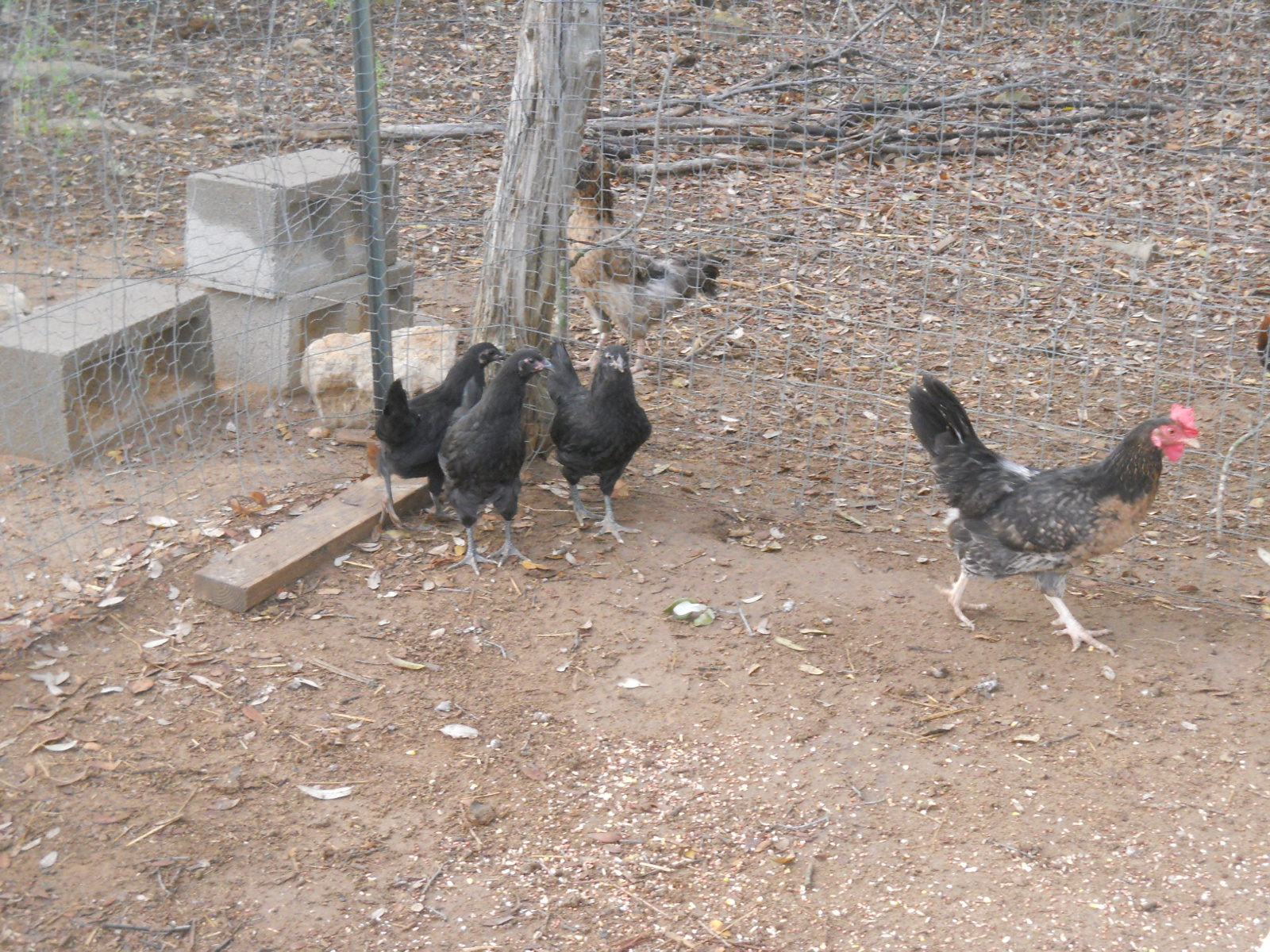
Since most of the chickens that we raise end up spending some time growing up in the chicken pen area, which was put in an area shaded with oak trees, they end up liking to stay, considering that home base, and often perch in the trees when bedding down for the night. Well, out here there are just too many harmful critters that roam around at night, so we try to make sure to get the chickens into the chicken tractor. If I couldn’t stand on the chicken pen’s coupe, I was having to climb some of the trees to get them down. This got tiresome quite quickly.

One night, I thought I would try to just poke them out of the tree with something, and decided to try using the garden hoe. When I put the hoe head up to the chicken to push underneath it, I believe it just sort of hopped on; and I was able to just lower it down while it sat perched on the hoe head. Hmmm….let me try that again. And it worked again! And again, and kept working with very good success! Hey, pretty nifty! So, we thought we’d offer a demonstration of the Hoevator in action!

Once in a while, especially if I start the process too early in the evening, the chicken will fly off; but for the most part, it all works very consistently.

I know, it’s a simple thing, but it beats climbing the trees or trying to get the chickens to fly down. We’re thankful to the Lord for Him allowing us to discover this little chicken-retrieving technique!

— David
A House – Update XXIV – External Siding

The Lord has graciously supplied resources via help from others to be able to work on the external siding of our house. We’re very thankful to God and them to be able to begin to protect the most exposed under-siding areas, as the OSB only lasts so long in the elements.

First was the tar paper that Sue and I put up using a hammer stapler. We were told we should have put the windows in after the tar paper, but I guess it was a little late for that now. I suppose I should have applied some special tape to secure the tar paper to the window — perhaps I’ll plan to do that on the next ones:

House External Upper West Siding Tar Paper Installed
More External Upper West Siding Tar Paper Installed

I wanted siding that was durable, hopefully without having to paint it all of the time, but that could be used as lap siding because I like the look, and was not too expensive; and so I thought cedar fence slats just might accomplish the task. I also decided on using tan Deckmate screws, so if we needed to remove pieces easily we could, and because the tan color matches the boards nicely.

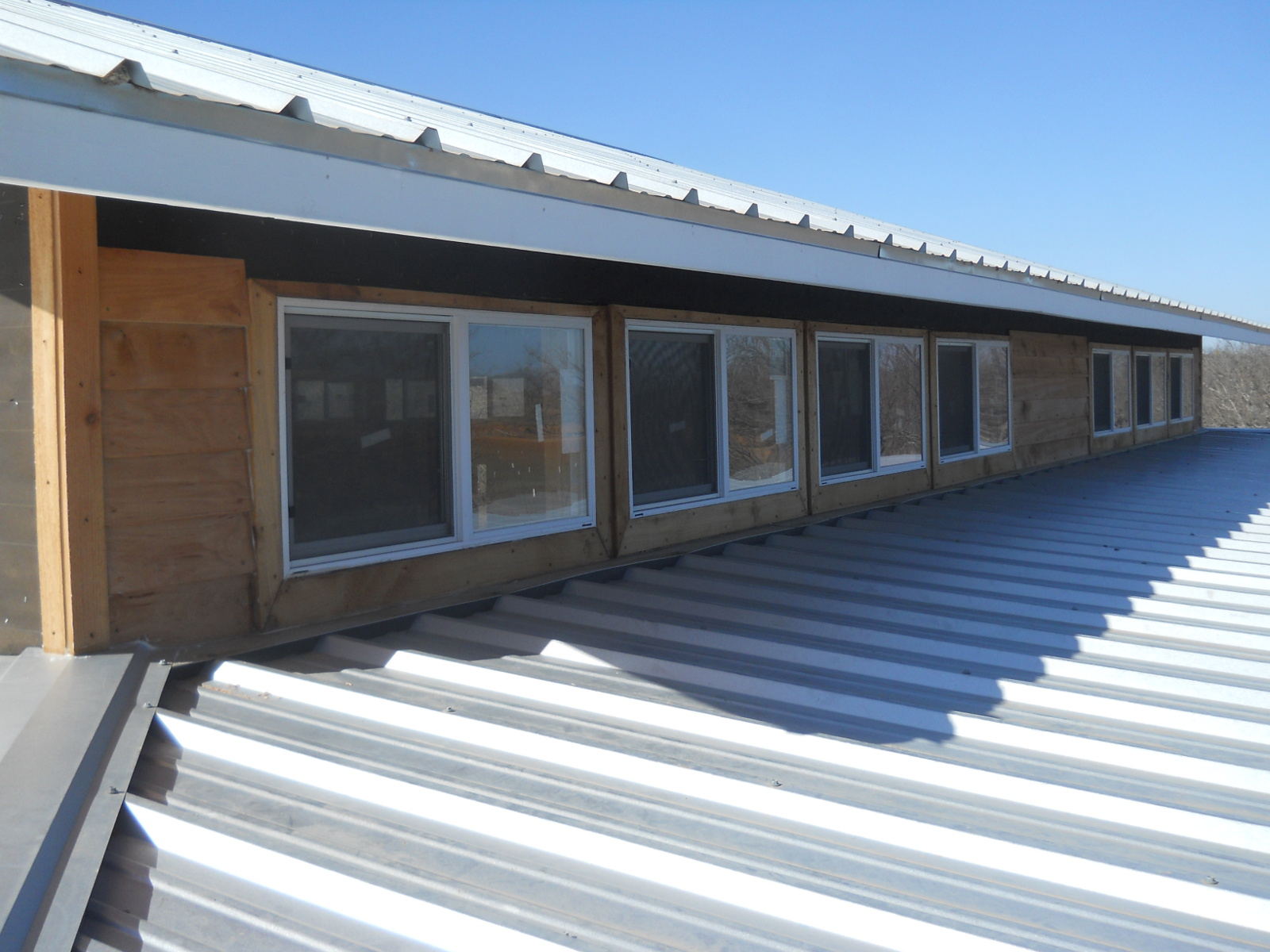
First was the window trim. For the bottom and top, I just ripped a slat (cut it length-wise) to fit the bottom, and then just used what was left on top, to try to save on slat usage. The trim is two boards thick — the under board corners are cut square to fit, and the top ones are miter-cut at angles for aesthetics, although with the funny (non-45 degree) angles, they didn’t end up joining together too nicely, but hopefully I’ll get better at that as I go. Because of the shape of the screws, I found I needed to drill pilot holes slightly using a 3/8 inch bit, so the screw head would sit nicely and not split the board; and I used 5 screws per full board, probably about 3/4 inch up from the bottom of the slat.

And because the window “flares” (the part that holds the window to the wall) stick out, and the top trim was so thin, I used shims to push the top of the trim piece a little more vertically level:

Upper Window Trim Top & Bottom with Shims

Here is the trim with the shims cropped:

Upper Window Trim Top & Bottom

And the window trim complete. All throughout the siding I tried to use copious amounts of clear silicone caulking:

Upper Windows Trim Complete

With the corner trim, I ripped the outer boards in a way so as to be able to cover the overlapping of the under boards:

Upper Corner Trim

And here are the windows and corners done:

Upper Window Trim & Corners Complete

Here is the corner to window siding. I initially thought I would run a string all of the way across to try to keep each course level, but with the distance of 40 feet, the string sagged; and so I figured once I got above the windows, I could even things out as I went, making sure the first course above the windows was generally the same height on one end of the house and the other. I was also able to follow the line on the tar paper on this first course, which helped set things fairly straight:

Corner to Window Siding

Because I worried that the slats might shrink some over time, I wanted to have a decent overlap, and ended up going with 5 inches of each course visible (the slats are around 5 1/2 inches wide). Each board-join I bevel-cut at 45 degree angles to overlap each join, hopefully helping to keep more moisture out, and I caulked each join as well. Given some of the slats would have arcs in their width, I’d have to try to press them flat when running the sliding chop saw through them:

Several Rows of Siding

Here is the roofline trim. At one point in this area, I started caulking and realized I was using white caulking instead of clear. Arg. I tried to wipe it off with wet cloths as much as possible, but some is still there, although at least I did it in a place that’s somewhat generally hidden:

Roofline Trim
More Roofline Trim

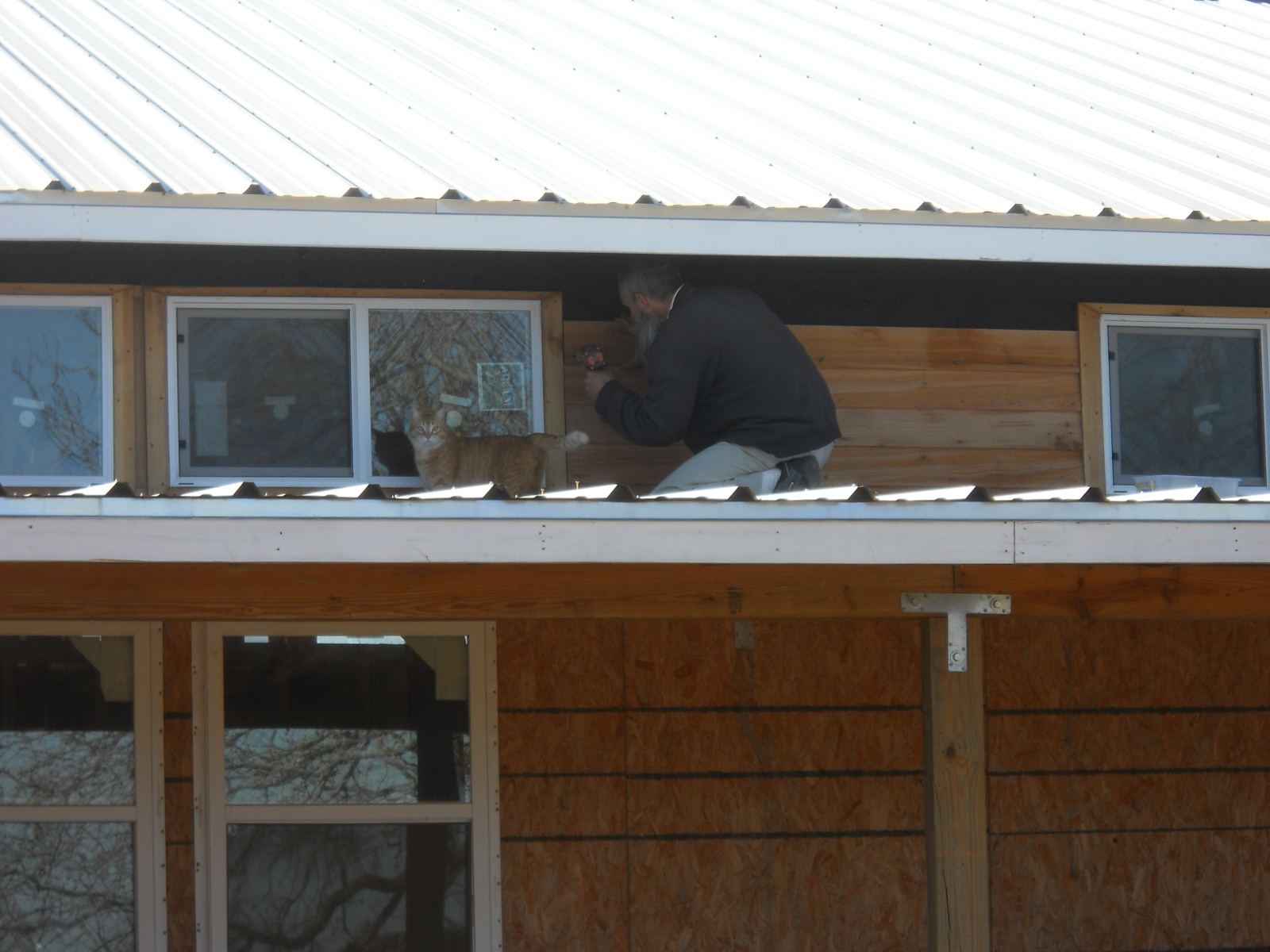
Here I am getting close to the top:

Installing Siding Near the Roof
More Installing Siding Near the Roof

And here is the first side complete! We plan to paint it with clear wood protector, once the colors settle, since it appears some of the red tinting in the boards seems to fade away over time; and we might paint the trim a different color, just so it stands out a little. It’s an amateur job, but I’m an amateur. 🙂

House External West Siding Complete

Because of time restrictions, it took several months to do this, but we are very thankful again to the Lord for granting this progress on the house!

— David
« Older posts Newer posts »