The Sifford Sojournal

Our journal of what we pray is our sojourn of life along the narrow way, even the old paths, submitting to the Bible as a light unto both.

Page 93 of 95

Garden 2007


2007 rolled around and we looked forward to starting our garden. We had learned some valuable lessons from the prior year, including building the rows with a trough going through the middle so the precious water wouldn’t run down the sides. There was a severe drought the year before, and we had received very little rain. Spring 2007 was pretty much the opposite in that it was one of the wettest on record, and we are extremely grateful for the bountiful water provisions.

We were able to supplement the garden with water from the well this time too, which was a wonderful help. We again thank God for this miracle in a region where underground water is very scarce.

The Lord granted very generous yields of tomatoes, green beans, cucumbers and cantaloupes:


This was my first delving into the process of canning food. We invested in a canner, and I was able to can 30 quarts of tomatoes and eight quarts of green beans. I had allowed myself to feel very intimidated because I had not grown up around anyone who did canning or preserving; but after carefully reading the instructions and canning my first batch of tomatoes, I felt very relieved and encouraged.

The trailer really heated up during each canning session but at least we didn’t have to pay to go to a sauna! Nothing like adding about 50% MORE humidity to a hot sticky summer day when canning in the trailer. (Just kidding – we’re very thankful to be able to do it). We hope to build a summer kitchen dedicated to cooking and canning which should really help to keep the trailer cooler.

For those of you who have gardens, you will agree that garden veggies are exponentially better tasting and healthier than store bought. Tasting store bought tomatoes after having fresh garden tomatoes is almost a crime. It feels like you have Novocaine on your tongue or it is wrapped in plastic wrap – WHERE IS THE TASTE??!! Amazing difference.

All joking aside, this is another wonderful picture of God’s sovereignty, in that, we are to be responsible to water and tend to the garden as God has instructed us to do (Genesis 2:15, 3:23), and God is the only One who provides, and is able to provide, the increase. As many examples in this temporal world shadow spiritual realities, we are reminded that He is also the only One who provides, and is able to provide, our spiritual increase. Praise God for His countless graces and mercies in His wonders and workings!

James 1:17 – “Every good gift and every perfect gift is from above, and cometh down from the Father of lights, with whom is no variableness, neither shadow of turning.”

Susan

Susan’s Musin’s – Journey Into Modesty (aka: I’m So Vain, I Bet This Blog Post Is About Me)

Some of you who have known me for years have already seen or will be seeing in the blog pictures a change in my manner of dress. So I thought I would write a bit about the thought and heart condition change process God has brought me through regarding that.

There are many verses in the Bible instructing women as to how they should conduct themselves in all areas of their lives. To be honest, growing up I didn’t really pay much attention to that instruction. As long as I was a nice person and didn’t dress like a floozy, I thought I was fine. But as I have studied those scriptures over time, the Holy Spirit has convicted and shown me how to live my life as a Christian woman, more Biblically correct and honoring to God.

I’m going to focus only on modesty in this post and will try to keep it brief.

1 Timothy 2:9-10 states:

In like manner also, that women adorn themselves in modest apparel, with shamefacedness and sobriety; not with braided (plaited) hair, or gold, or pearls, or costly array. But (which becometh women professing godliness) with good works.

Ahhhh, that word is adorn myself, NOT adore myself……

Okay, so then I looked up the definitions of the main descriptive words in that scripture from the Noah Webster 1828 Dictionary:

Modesty: In females, modesty has the like character as in males; but the word is used also as synonymous with chastity, or purity of manners. In this sense, modesty results from purity of mind, or from the fear of disgrace and ignominy fortified by education and principle. Unaffected modesty is the sweetest charm of female excellence, the richest gem in the diadem of their honor.

Shamefacedness: Bashfulness; excess of modesty.

Sobriety: Seriousness; gravity without sadness or melancholy.

Costly: Of a high price; sumptuous; expensive; purchased at a great expense; as a costly habit

I also looked up these words in the modern Webster dictionary where many original meanings of words have been lost. However, it was fairly consistent with the 1828 dictionary intermingling definitions of these words with “pure, chaste, decent, shy, clean, spotless, freedom from conceit or vanity, severely simple in design or execution, free from ALL taint of what is lewd or salicious”.

So in a nutshell, as a Christian woman:

  • I am clearly instructed in the Bible to wear (severely) simple, modest clothing (sending a message of chastity, purity) emphasized by shamefacedness (an excess of the aformentioned chastity and purity) and sobriety (to be steadfast and consistent in sending this message) by the clothes and other items I wear outwardly.
  • I’m also not to focus on bringing attention to myself through lots of jewelry or “bling”, fancy or expensive clothing but to keep things simple, pure and unassuming.
  • My main focus is to take the attention off of my physical person and live my life in obedience to God so the fruit of my salvation brings glory to and points people to God.

Okay, so now I had to take these definitions and lay them across my wardrobe to see if there was a “fit”. Well, if I was totally honest with myself, I would say my clothes, as modest as I thought they were, still stated “Hey, HEY! look at me”, “Do you think I have a cute figure?”, “Isn’t this outfit cool?”, “I’m very proud of the way I look”, “Even though I’m married I still need to stay ‘competitive’ with the women in the world so my husband’s eyes won’t wander”. It was very humbling and convicting.

I also noticed that my wardrobe just wasn’t very “feminine”. I rarely wore dresses except to weddings and maybe a special occasion here and there. Otherwise, it was sweats, shorts, pants, pant suits, etc. I think society defines femininity as “tighter” pants and “tighter” shirts, etc.; but the Bible clearly teaches something different. God is very clear in the Bible that He made men and women completely different with different roles. And women are to look completely different from men as well.

Well, as hard as my flesh fought it I knew I had to make some pretty big changes. And I knew this newfound knowledge didn’t now give me license to “let myself go”, become a slob or not be presentable. I was even more accountable to God to represent Him in the world as one of His children. So over time I started buying and wearing inexpensive, simple, longer skirts and dresses, not showy or clingy but …….modest!

And I have to tell you even though my flesh struggles, in my spirit there is a sense of peace and rightness because I know this is how the Bible has instructed me to present myself as a Christian woman.

And you would think I would have become pretty invisible to the world; but I have discovered that my conservative manner of dress is very noticeable to the world, and they sense something different about me. I was not instructed by God to adorn myself with clothes to fit in with the world or so the world would be attracted to me but to adorn myself with modesty and obedience to His word to point them to Him. So it’s not all about me after all – who knew??!!!

The scary thing to me is that I was totally unaware of how my conduct and dress was an act of rebellion and disobedience to God, and I didn’t even realize it. I’m so grateful to Him for opening my eyes to it and giving me a desire to study it, repent and make the necessary changes.

Susan
Storing Rain III

We have already discussed two water sources which we had hoped to have here on the land: catch water systems and ponds (tanks). The third we had hoped for was to be able to have a well on the land, which is retrieving water that is stored underground, which is referred to as ground water.

Before moving down, we had purchased a do-it-yourself well driller; and after much travail, came up empty. And so I believe it was later 2006 we hired a local driller to come try to drill a well for us.

The drillers came out and asked where we would like to drill down. I had picked a spot that was somewhat between where we had planned to put a house and where we planned to put a barn, near the south fence of our fields. Those were the criteria, which obviously wasn’t much in the way of improving the possibility of hitting water, especially when the drillers still charge a per foot drilling fee regardless of if you hit water or not. But we didn’t really know of any other options, and so we proceeded.

Here is a picture of the drillers drilling:

Now, apparently hitting water out here, and hitting good water, is quite iffy. First, from what we’ve heard, there isn’t a lot of ground water available, and we are not located on any aquifers. Plus, with all of the salt water pumped into the ground during oil drilling processing of the past, the water could be unusable.

Well, as God would have it according to His graces, mercies and provisions, the drill hit water somewhere around 140 feet, and the fellow running the drill was able to taste a little and said it was pretty good water! They drilled down a little further and cased the well. Later, we were able to put a pump down it powered by a diesel generator, and thusly the Lord most graciously had granted us a working well on the land. We have since also purchased a deep well hand pump to be used if we are unable or unwilling in the future to run the generator or get a replacement pump if either fails.

At first, the well seemed to pump out an unlimited amount of water, and we got used to having that much available. It seemed we started to become a little complacent in our thankfulness for the water. Eventually though, the amount started to be limited, and I began to worry about having enough water. However, at some point, Sue, the wonderful help-meet the Lord has granted me, stated that apparently the amount of water the Lord granted from the well on a given day is exactly the amount He has provisioned for us for that day. This certainly rang true with me, and through Sue He has helped me trust Him more in regards to water from the well. We have since seen several times where the amount of water we thought we needed for the day for animals and the like was just about the exact amount that did come out of the well, and there have been times when what we thought we needed didn’t come out. Either way, now we try with God’s help to make sure we are continuingly grateful for and content with the water resources of the well that He has granted.

And as I mentioned in the first Storing Rain, we are also very thankful to the Lord Jesus for the spiritual water of life that comes from Him.

— David

David’s Digest: “F” in Faith

After learning about the doctrines of grace and God’s sovereignty, I believed I understood about God’s perfect will in every circumstance. But I have since discovered that while I may have on my lips that I trust God, whether I have a true faith or not and a true one in the heart might be something else.

After we moved our chickens into our chicken tractor, during the first Spring with them all there (Spring 2006), one of our hens went broody; and in the end she hatched out 5 chicks: one died young, getting her head caught up in chicken wire; one had leg problems and couldn’t really walk and was killed by something (a critter perhaps?); and 3 survived: one rooster and two hens.

As they grew, they became very familiar with us, and us with them, as evidenced by this un-staged picture:

They would hop in my lap and sit down under my spread out arms, or climb on my shoulders, all without any coaxing. This endeared them to me, even more than they already were, being that we had known and taken care of them from the day they were hatched. We named the rooster “Russell” (based on what he would do early in the morning as a rooster — think movie actors; that’s Russell on my shoulders in the picture above), and the hens were just “2” and “3”. All of this helped feed some carnal affections in me, which I hope to discuss in a future “Digest”.

Anyway, Sue & I hadn’t moved up to our section of the land yet, and so we would have to walk up and check on our chickens during the day to make sure they had water, etc. One Lord’s Day after fellowship time, after walking up I noticed feathers strewn all over next to the fence line. I tracked them visually into the woods, and then to Russell, lying still, partially eaten. I exclaimed with an “Oh no!”; and when I did, a critter having Russell for dinner, which I hadn’t seen, flew behind a tree. I scrambled to find a place in the fence to jump over so as to run back there, but then the flying critter flew into the air and away.

I got to Russell, and he was indeed gone. Immediately the wheels of my mind started turning. Sue soon joined me, and I told and showed her what had happened.

And then the ugly truth came spewing forth, verbally to Sue: What was God doing (which if asked in honesty to learn isn’t necessarily bad, but that’s not how I meant it)? How can we have food from our chickens through perpetuation if He’s going to take them? Why doesn’t He just take them all right now and get it over with?

Yes, it was that bad. All the things I claimed about understanding and believing in God’s sovereignty were nowhere to be found. The heart had spoken.

Well, I believe it was an hour or two later, by God’s graces and mercies, I came to myself (cf Luke 15:17) and realized what I had done; and I found out by that test that day what was apparently the real situation in my heart: my grade in Faith was an “F”.

I was devastated and distraught. I had betrayed God, and as head of my family had done so in front my wife. Where was the faith I claimed to have, especially given such a relatively small incident? I was evidently found wanting (lacking).

However, the Lord graciously granted that I begin to seek from Him His forgiveness, and seek from Him a granting of repentance and a true faith in Him. I also had to seek forgiveness from my wife and admit to her my grave fault in how I had reacted.

Since then I have had time to reflect on that event. I still lament my actions that day, and I continue to ask Him for a true faith. I pray He writes this faith on my heart.

But why is knowing whether you have a true faith important? The Bible says in 2 Cor 13:5, “Examine yourselves, whether ye be in the faith; prove your own selves. Know ye not your own selves, how that Jesus Christ is in you, except ye be reprobates?“. Having a true faith is linked to having Christ! (Read the gifted expositor John Gill’s commentary on this verse). Further, Heb 11:6 says, “But without faith it is impossible to please him: for he that cometh to God must believe that he is, and that he is a rewarder of them that diligently seek him.“. And so it is of utmost importance that we know our faith condition.

Finally, how can we know if our faith be a true one? It must be tried; and so, not only am I grateful to Him for this test He granted, but I also ask that He continue to test my faith as necessary to evidence it as being a faith that has indeed come from Him. I pray these things be for His glory and my assurance, if He might grant that.

1 Pet 1:6-9 – “Wherein ye greatly rejoice, though now for a season, if need be, ye are in heaviness through manifold temptations: That the trial of your faith, being much more precious than of gold that perisheth, though it be tried with fire, might be found unto praise and honour and glory at the appearing of Jesus Christ: Whom having not seen, ye love; in whom, though now ye see him not, yet believing, ye rejoice with joy unspeakable and full of glory: Receiving the end of your faith, even the salvation of your souls.”

Little did I know when that rooster chick was born and we watched it grow, when it would sit on my shoulders, that it and its death might be one of the means that God would use to perhaps save my soul.

May God grant us in our hearts His tried and true faith, for His glory; and may we persevere in that faith until the end.

— David

Cattle


Our next venture into animal husbandry was cattle. We initially wanted them as another source of food, specifically for myself steaks and burgers! 🙂

I cannot recall exactly how it all unfolded, but I believe Michael had considered Texas longhorns as a possibility, perhaps because they are Texas cattle; there may have been other reasons. And then God’s providence would have it that the naturopathic doctor Sue and I were seeing knew one of the foremost Longhorn cattlemen around, Frank Sharp, and he lived in the major town near us. So we called him and started discussing Longhorns. Come to find out he not only knew about Longhorn cattle, but had done his doctoral dissertation on them. And so, the Lord was gracious in leading us to him, and then the registry group of which he is a part, the Cattlemen’s Texas Longhorn Registry: the CTLR.

Rather than myself explain why we went the Longhorn route, Michael did in a blog on it:

True and pure Texas Longhorns are profoundly different from the commercial cows (actually European breeds) that are available today. So it is not just a few minor trait differences we are looking at, but actually the Longhorn is “a whole different animal”.

The pure Longhorn is a smallish example of cattle. The female rarely tops 800 lbs. The Steer or Bull may get upwards of 1800 lbs. but it will take him 5-6 years to get that big.

The Longhorn thrives on stuff other cows will not even eat. They will eat weeds, thistles, scrub brush, etc. as well as grass when it is available. The result of these first two traits is that you can keep 3 Longhorns in the same area where you could only keep one commercial cow. The commercial cow is designed (by humans) to live a fairly short life. Finding a 10 year old commercial European breed cow is very, very rare. The commercial cow will likely only produce up to 5 or 6 offspring in their short lives. The Longhorn, however, can live very long lives, and it is not unheard of to have a cow still producing a calf (every 10-11 months) well into their 20’s and 30’s. The Longhorn breeds back faster than any other cow. The old saying by ranchers is that the Longhorn will calf every 9 months and 15 minutes.

The Longhorn survived and thrived in the deserts of Texas and Mexico without any aid from or crossbreeding by man. The commercial breeds are concoctions of man… the true Longhorn is a product of God. After hundreds of years living wild in Texas and Mexico, there were literally millions of pure Longhorn cattle free for the taking. This is what started the “cattle drives” of western fame. The Longhorn saved Texas after the disastrous war of northern/industrial aggression.

So how is the meat?

Longhorn meat is higher in “good” fats, lower in “bad” fat, and higher in protein than any other beef. It is naturally one of the most tender examples of beef, even though it is the lowest in saturated fats. I was given a couple of pounds of Longhorn hamburger and it was some of the best hamburger meat I have ever eaten.

Longhorn steers can be made into oxen (and have for centuries). Longhorns can be ridden and milked.

Longhorns are the only breed where almost 100% of the cow is usable and profitable. Not only is their meat great, but the horns regularly sell for between $400-$1500 dollars. The hides sell for between $400-$700. Online you can buy Longhorn pillows, couches and blankets (try to buy an Angus blanket!). The tails are often made into lamps and even putters! An industrious Longhorn owner can sell the hides and horns for more than a whole commercial breed cow will sell for at market. This doesn’t count the meat at all!

The main points for the homesteader:

1. 3/1 ratio of Longhorns to a commercial cow in the amount of cows per acre.
2. There is no known case (of which I have either read or heard) of a Longhorn cow having to have a calf “pulled”. Ease of calving is a famous trait of Longhorns, and it is why many, many commercial breeders now have their cows bred to a Longhorn bull for their first calf.
3. Low feed costs and the ability to keep a cow on land that might not be good enough for a commercial cow.
4. Multiple uses of the Longhorn. Milking, riding, pulling, work, etc.
5. Easy sale of all the “parts”.
6. Quality of the meat.

Well, this seemed like a no-brainer to us; and with the CTLR folks’ help, we were able to begin our herd.

In having animals on the farm, we have learned that is seems each type of animal has its own naming conventions for adults, its offspring, etc. I would like to quickly go over a few definitions of words that regard cattle that might be used in this post. I never knew these before owning any, and even at the beginning when people would use the words, I would sort of just nod my head and smile. 🙂 And so:

– A “calf” is a young cattle offspring
– A “bull” is an un-castrated male
– A “steer” is a castrated male
– A “heifer” is a female that has never given birth
– A “cow” is a female that has

And so, a newly born male would be referred to as a “bull calf”, and likewise a newly born female a “heifer calf.”

Our Herd

In naming our cattle, we wanted to have a Spanish theme for ours, given the heritage of Longhorns. The picture at the top of this post Amistosa (“friendly”) and her calf Tiara (because she has a crown of white on her head).

Here are some other pictures of the cows and heifers we own. This is Rosa (“rose”) and her calf Rosalinda (“pretty rose”, and that she came from Rosa):

This is Ami and her latest calf Casi Blanca (“almost white”):

This is Catalina (“pure”), which we bought from Frank:

And here is Rosa’s latest calf Rociada (“sprinkled”, because of the coloring on her face and the “ros” sound, like in her mother’s name):

Although the horns of the Longhorn can be intimidating, and one must be careful around them (especially not to startle them and to pay attention to the possibility of accidental horning), the Longhorns are very gentle generally. Tiara’s like a puppy dog now in how she behaves, and here’s a picture of me training Tiara:

It’s interesting to note that while it might be thought that Longhorns’ horns are their main weapons against predators, apparently their preferred method of protection is stomping an attacker to death. The newborns also learn to get around quickly so as to be less vulnerable to predation.

Recently we had to move the herd from one field to another about 2/5 of a mile down the county road. Needless to say I had stopped a couple of times during the jaunt. Just a couple of notations: The first heifer to come across the line was said to be Maria, but actually it was her calf Pita (both owned by Michael). Also, the bull mentioned, Quitachon, was not actually our bull but was borrowed from Sonny Detmer of the CTLR:


One thing we’ve learned about cattle is that they get into everything. You have to fence them out of areas in which you don’t want them. But when they get in, they step on things and break them, they’ll get into your chicken tractor and eat the chicken feed, and a 4 foot fence around an orchard tree will not keep them from eating the tree down. Plus, some of the cows are quite dexterous and will jump your fence to get to greener pastures, which means chasing them or luring them back to the field in which you want them with “range cubes”. Range cubes are feed pellets that are anywhere from an inch to 3 inches long and about 1/2 to 3/4 of an inch in diameter, and the cattle love them! Further, if a gate is left open and they all get out, it ends up being an all out round up trying to get them back to their proper place. However, if you can get one or a few of them going, the rest typically follow, sticking with the herd (just like in the above cattle drive).

It has been a blessing to be able to have the cattle that God has granted us. In the long run, for us to keep animals, they need to perpetuate. The Lord has been gracious in allowing our cows to reproduce; and this year, Lord willing, our first heifers born on the land will be producing their own offspring. We are thankful again for God’s provisions.

— David

Storing Rain II


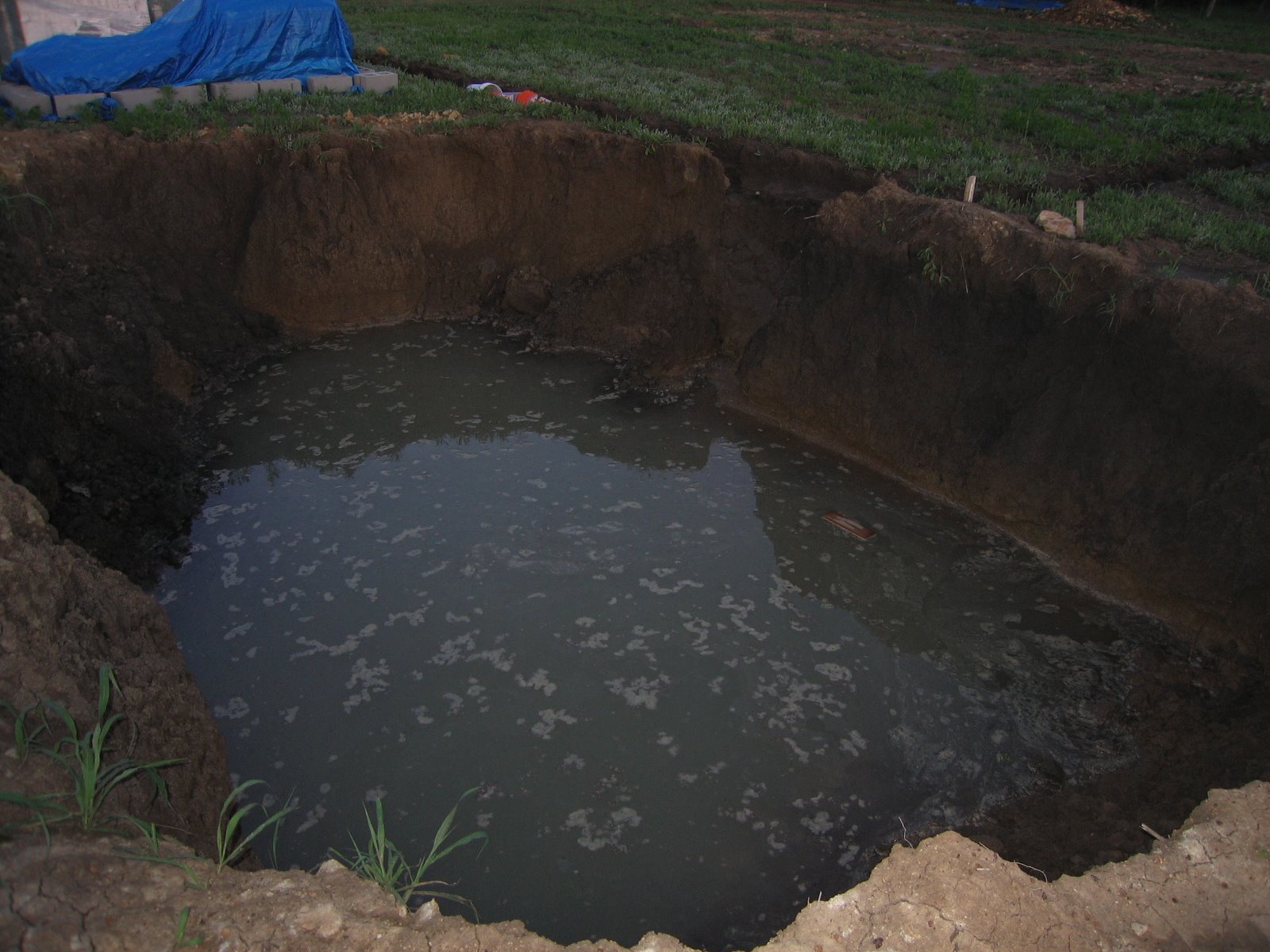
As I’ve mentioned previously, Lord willing, we wanted to be able to have 3 main water sources available on the land: the first was rain water, and the second was surface water. Our section of the property had a pond (tank) on it under a beautiful oak tree (seen here to the left). I thought though that perhaps it would be a good idea to expand this tank, as it seemed to be somewhat smaller in size; I was hoping to add a section 1 1/2 times the size of the original (making the new overall size of the tank to be about 2/3 of an acre), having trenches connecting the two sides with an island in the middle and bridges across the trenches. Also, I was hoping to make it big enough to be able to add fish to it as another food source. And so thus began the pond expansion project.

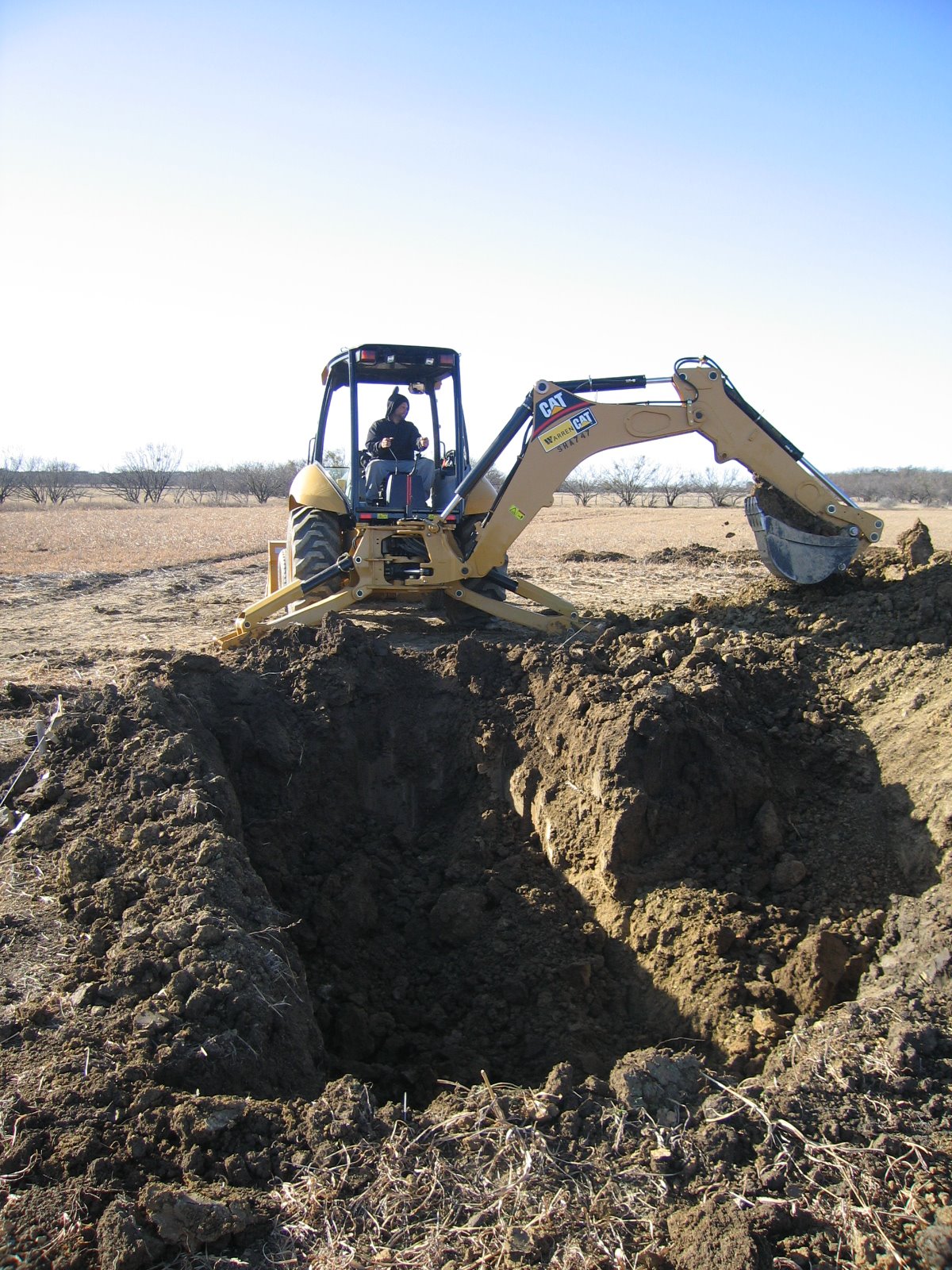
At first I started digging it by hand. Um…yeah. I realized soon that this would have probably taken several years of steady working at it to be completed. And so, it was time to rent the backhoe.

Here’s foreman Gary telling me to get back to work!

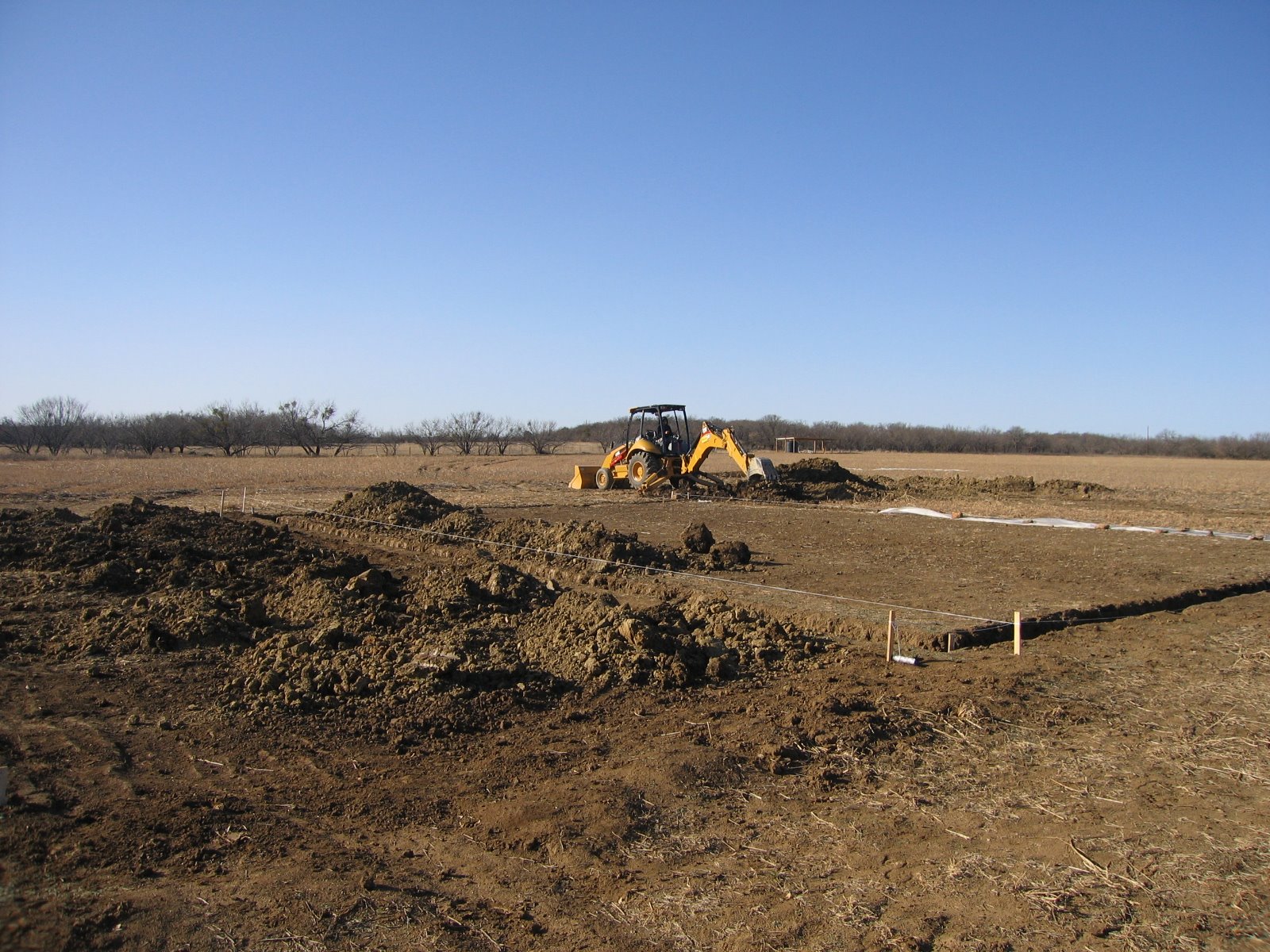
With me back on the job and able to accomplish the planned digging and dirt moving, here are some before and after pictures:

Before, the south side of the original tank, looking from the outside:

After, with the trenches:

Before, facing west in the new area:

After, facing west in the new area:

Before, from the new area facing the oak tree:

After, inside from the new area facing the oak tree:

After, outside from the new area facing the oak tree:

And here is the original, now more dug out, area after some rain:

And here the new area after that rain:

It rained quite a bit last year and the Lord graciously filled the new area up to about 2 feet from the top of the draining side. However, with the newly placed dirt, much of it leaked through the sides at the bottom. I also need to go back and reshape some of the walls a little, now that I’ve had the opportunity to see the water levels around the banks. And so, we are praying that eventually the dirt settles and that the Lord over time graciously fills it back up, granting us this second resource for water and hopefully another source of food.

— David

Introducing Gary

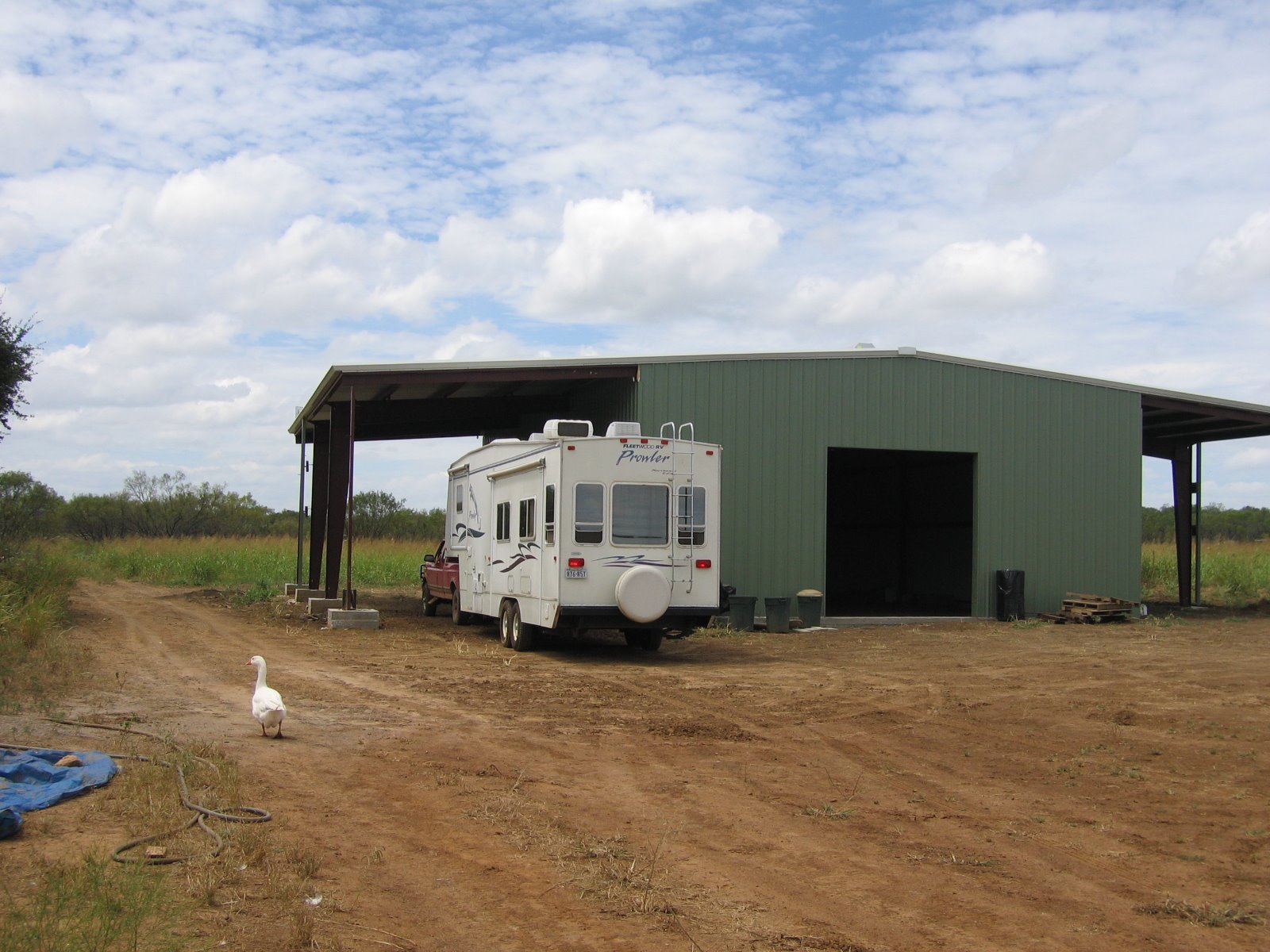
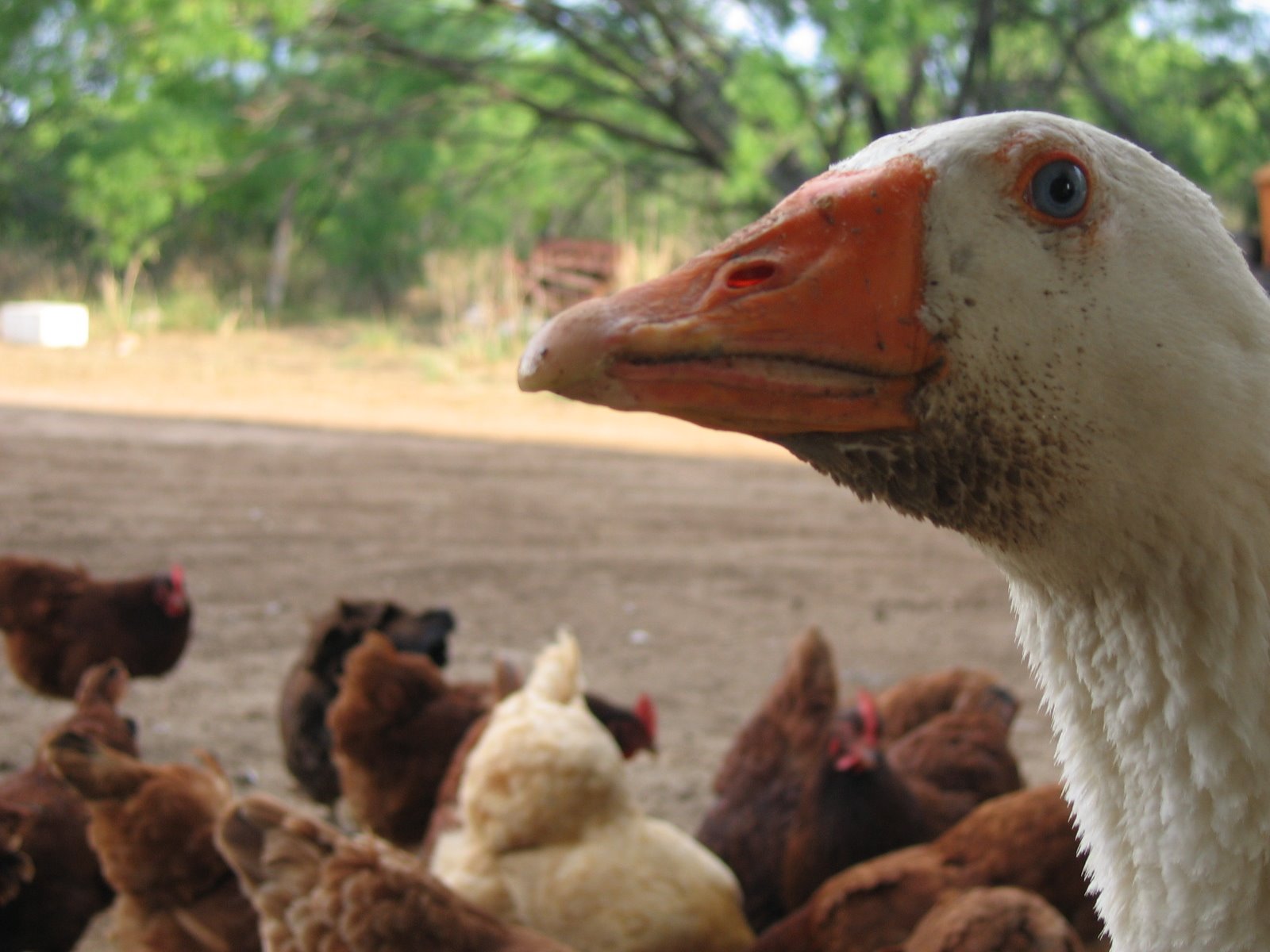
Before we go too much further with things, let us introduce to you Gary the Goose. Gary was originally the Michael and family’s goose from when they lived up north, and they brought he and his mate down with them when they moved. Gary’s mate sadly was taken out by some critter one day or night, and so Gary was left alone at the their pond. Geese apparently mate for life, are protective animals, and often die soon after their mate dies. Well, Gary seemed to have some different ideas, because he appeared soon after to adopt to himself a gasoline engine powered water pump they were using to pump water from their pond (we assume because it made noise). However, with the frequent visits from one of the young men working in Michael’s household, Gary moved on to adopting him and slowly made his way up to their cabin area, following this fellow around wherever he went.

Well, Gary started disrupting the their brooding hens, and Michael was not pleased with that. “Unless circumstances change…to the soup pot with you, Gary!” he declared. We thought, hey, we have room for him and he’s not much maintenance, so we offered to take him. Michael let us have him, and we moved him up to our land.

Here’s moving day:

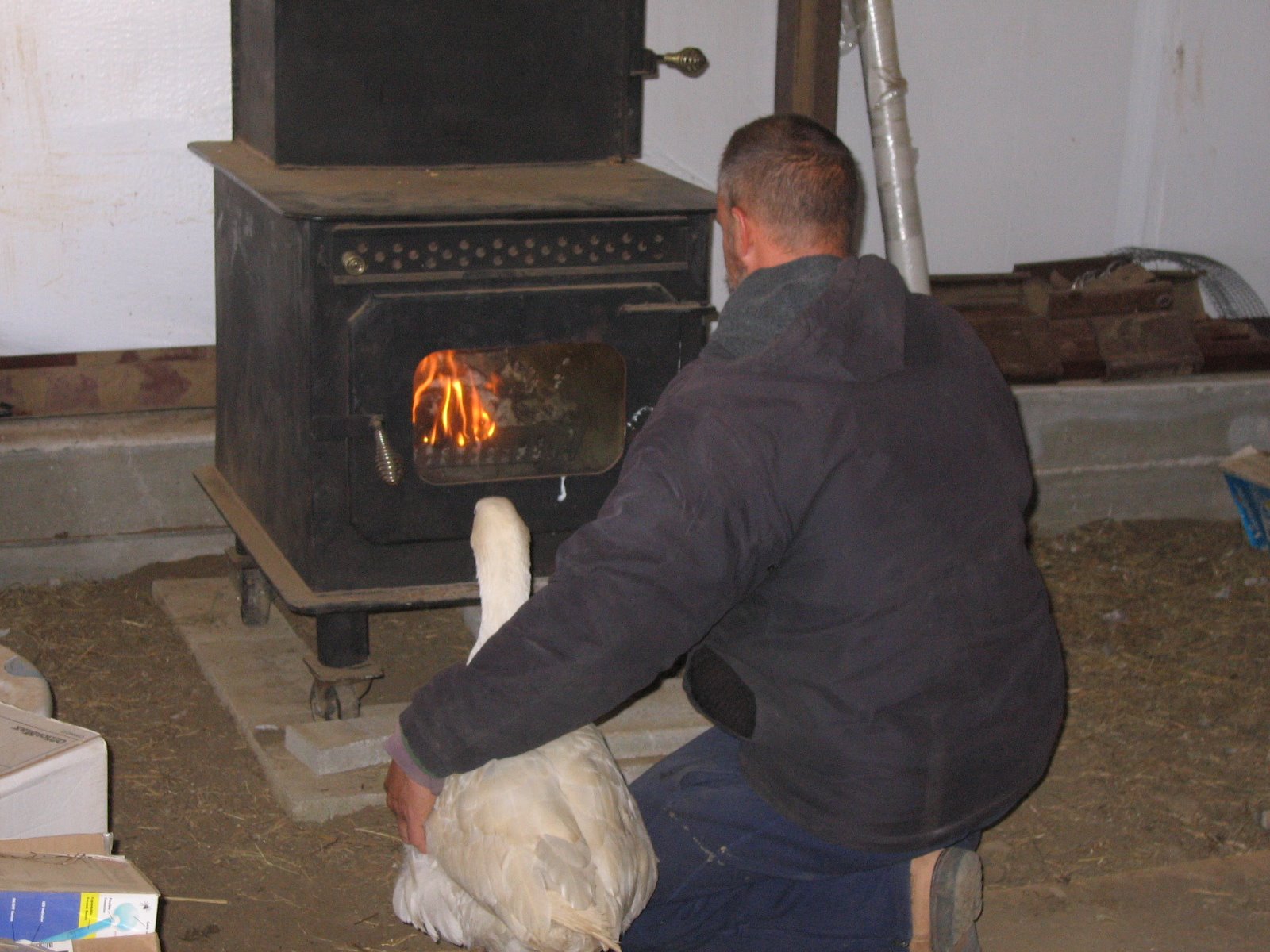
Since then, Gary has pretty much inserted himself into just about every outside aspect of our lives. He follows David around just about everywhere he goes (apparently David is Gary’s new adoptee). In fact, in order to get away, David has to have someone hold him back, drive a vehicle, or lure Gary into the barn (we’ll get to the barn in a future post, Lord willing) and then exit the back side. We have had to be careful about letting him follow us on hot days because he will start to overheat with that down comforter he’s wearing.

He sticks with David through thick and thin:

Sometimes David will walk him down to our pond and let him swim around and “freshen up” for a while down there. He lets David know when it’s time to go by walking up to him away from the pond.

During Spring and Summer, he pretty much lives on the grasses and the like that grow naturally on the land. Otherwise, we give him chicken scratch. Also, he will let us know when the neighbors are coming by squawking away; he’s something of a pretty good watch-goose.

Gary vs. The Bucket

In this corner, weighing in at 7 pounds…Gary the Goose! And in the other corner, weighing in at 12 ounces, The Bucket!

As you can see, he is not fond of buckets. He appears to have a problem with tools and water containers as well. Sometimes we have to put in him the chicken pen while we work to keep him at bay. We have however recently discovered that tossing him through the air away from the scene seems to snap him out of it a bit.

A Conversation with Gary

The Star of the Show

This following video was supposed to be of our new chicks:

As you can see, we have a lot of fun with him. 🙂

And so there you have Gary the Goose. Keep an eye out for him in future posts, and see if you can spot him when he is in one!

— David & Susan
« Older posts Newer posts »